Fundraising for Southeast Asia-focused venture funds deteriorated materially in 2025, with the second half of the year marking the weakest stretch since tracking began, finds DealStreetAsia DATA VANTAGE’s latest bi-annual report.
Only one fund reached final close in the second half: Philippines-based Kaya Founders, which secured $25 million for its Fund II, according to SE Asia Venture Funds: H2 2025 Review. The outcome reflects a clear flight to conviction, with LPs concentrating capital behind managers with demonstrated DPI visibility, disciplined deployment and defensible sourcing.
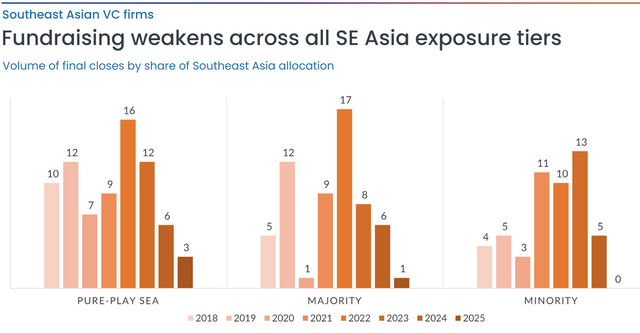
Full-year 2025 closed on a muted note. Total final closes in the year fell to four, down from 17 in 2024 and 33 in 2023. The step-down underscores a protracted capital formation slowdown, with LPs consolidating commitments around differentiated strategies, governance resilience and credible exit pathways rather than broad regional exposure.
Singapore led the contraction. The city-state recorded just one final close in 2025, versus 10 in the prior year and 21 in 2023. The pullback signals more than cyclical caution; it points to a structural recalibration of global LP allocations within Asia.
A mix of macro volatility, heightened governance scrutiny and fragile startup unit economics compressed LP risk appetite and extended fundraising cycles, particularly for emerging managers and broader mandates, the report said.
Incremental capital has increasingly rotated towards India, where deeper liquidity, larger exit comps and clearer scale narratives are absorbing a greater share of regional allocations. In relative terms, Southeast Asia is competing harder for global venture dollars.
Squeeze across the board
Debut vehicles have borne the brunt of the 2025 fundraising downturn. No first-time manager reached final close in the second half, and for the full year, only one debut fund crossed the milestone: Kayella Consumer Partners, which announced the final close of its maiden vehicle in May in the double-digit million-dollar range.
The collapse is stark. Debut final closes have fallen from seven in both 2024 and 2023 to effectively a single reported close in 2025. This also marks a sharp reversal from the 2018 peak, when 14 first-time managers reached final close in a far more receptive LP environment.
No first-time manager reached final close in H2, and for the full year 2025, only one debut fund crossed the milestone:
The trajectory points to LP retrenchment toward established franchises, the report argues. In a risk-off climate, track record, governance depth and distribution visibility have become decisive filters, making it structurally harder to seed emerging GPs and narrowing the pipeline of new managers across Southeast Asia.
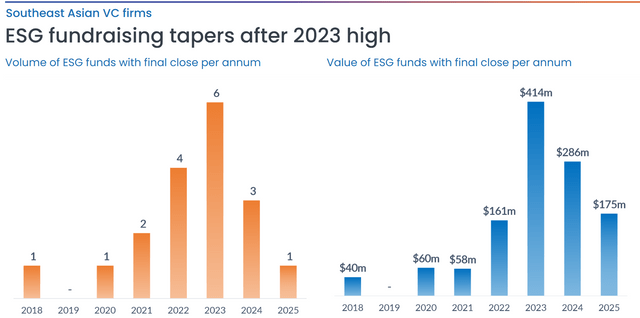
ESG-focused vehicles have also lost momentum. Singapore-based Clime Capital’s SEACEF II, which announced in March that it closed above target at $175 million, stands as the only climate-focused fund to reach final close in 2025.
This compares with three climate-focused closes in 2024 and six in 2023—the cyclical peak. While Southeast Asia has cumulatively recorded 14 ESG-labelled venture funds raising over $1 billion, two consecutive years of decline signal a clear deceleration in marginal fundraising appetite.
The cooling mirrors a broader global reset. Green- and ESG-labelled strategies are facing higher scrutiny and shifting LP priorities, requiring managers to demonstrate commercial durability and credible exit visibility alongside environmental intent in an increasingly liquidity-constrained market.
Unlocking LP capital
Fund managers interviewed for the report emphasise credibility over narrative as the decisive factor in unlocking LP appetite. With capital scarce, LPs are prioritising demonstrable track records, structural differentiation and clear pathways to liquidity over thematic positioning alone.
For Clime Capital CEO Mason Wallick, conviction was built around addressing a structural capital gap. SEACEF II reached its $175 million hard cap by deploying early-stage capital into Southeast Asia’s underfunded clean energy transition, writing $1-3 million initial cheques and following with scale-up capital where few others operate.
The strategy deliberately avoids unproven technology risk, focusing instead on commercially validated solutions applied in complex markets. Importantly, realised exits from SEACEF I reinforced the case that liquidity is achievable even in constrained conditions, providing tangible proof points for LPs.
“Our track record from SEACEF I demonstrated that exits are achievable in this market, even when the broader exit environment remains challenging. That proof point was material to LP conviction in this cycle,” said Wallick.
Fandy Cendrajaya, the founding partner of Indonesia-based Kopital Ventures, takes a more direct view: the unlock is realised outcomes. Even modest early distributions can materially strengthen fundraising conversations by demonstrating that judgement converts into cash.
He also highlights three structural enablers: deeper secondary markets, clearer regulation in emerging sectors, and more credible IPO and M&A pathways. Together, these expand liquidity routes and reinforce LP confidence in returns that are not merely marked up, but realised.
Multiple exit routes
As fundraising tightens, the exit environment has moved to the forefront of LP underwriting, the report said. Managers increasingly frame Southeast Asia not as a market reliant on a single IPO window, but as one where multiple liquidity pathways are gradually institutionalising and becoming more predictable.
Jefrey Joe, co-founder and general partner at Alpha JWC Ventures, argues that the region’s exit landscape has matured in step with deeper M&A ecosystems and stronger public exchanges. In his view, liquidity is no longer binary but diversified across several viable channels.
He highlights three emerging trends reshaping the exit landscape. First, strategic M&A is expanding, particularly from regional corporates and North Asian buyers targeting Indonesia and the wider region as they pursue cross-border growth. Second, secondary transactions are becoming increasingly institutionalised, with continuation vehicles and structured secondaries enabling partial liquidity without requiring full exits.
Lastly, public markets are reopening selectively. Profitable, governance-ready companies are regaining access to regional exchanges and, in some cases, the US, suggesting that IPO pathways, while disciplined, remain viable for quality issuers, Joe said.
“Danantara, Indonesia’s sovereign wealth platform, plays a catalytic role in deepening domestic capital markets by acting as a long-term strategic investor and cornerstone anchor in IPOs, particularly for national champions in sectors such as energy transition, infrastructure, healthcare and downstream industries,” Joe added.
Separately, Cendrajaya acknowledges the growing role of secondaries in reinforcing LP confidence. With record global volumes in 2024 and sustained momentum into 2025, secondaries provide managers, especially newer funds, with additional avenues to return capital earlier, provided their portfolio companies can attract later-stage buyers.
Private equity tilt
As venture funding remains subdued and exits constrained, several firms once positioned as pure-play VCs are pivoting towards hybrid or multi-asset models with a more private equity tilt. The shift reflects LP demand for yield, downside protection and greater capital flexibility in a slower liquidity cycle.
Private credit has become the primary expansion vector, though such vehicles are not included in this report. Granite Asia launched its Libra Hybrid Capital Fund, securing a $350 million first close towards a $500 million target. January Capital also closed its APAC private credit fund at over $130 million in December, underscoring institutional appetite for income-generating strategies alongside equity exposure.
Branding shifts reinforce the repositioning. Openspace Ventures has rebranded as Openspace Capital and is reportedly exploring private credit, while AC Ventures is now ACV Capital and positions itself as a growth equity firm, signalling a structural broadening beyond traditional early-stage mandates.
ACV Capital founder and managing partner Adrian Li describes the rebranding a deliberate pivot towards durable opportunities in Southeast Asia. As the market reset, it became clear that the next phase of value creation would require greater financial and operational discipline.
“Positioning ourselves as a private equity firm focused on profitable growth signals exactly that: disciplined underwriting, structured governance, resilient unit economics, and a clear line of sight to liquidity,” Li said.
Li said ACV Capital differentiates itself from traditional mid-cap private equity firms through its operating-level technology expertise built over a decade of backing tech and tech-enabled businesses.
“Over the long term, our vision continues to be the premier partner for empowering entrepreneurs to build the most valuable and enduring businesses in Southeast Asia,” Li concluded.
The SE Asia Venture Funds: H2 2025 Review has extensive data on:
- SEA VCs that secured final or interim closes in 2025.
- VCs that launched new funds in 2025.
- Climate-focused VC funds that secured fundraising milestones.
- Global VC funds, with a mandate to invest in SE Asia, that secured funding milestones.