
Southeast Asia’s fast-growing coffee and tea chains are entering a new phase of competition where operational systems, and not branding or store expansion, are emerging as the key differentiator, according to a new report by Momentum Works.
The region’s modern coffee and tea market reached $9.9 billion in 2025, marking a 52% jump from $6.5 billion in 2021, as rapid outlet expansion, digital ordering, and broader consumer adoption fuelled growth.
But beyond that expansion, the industry is undergoing a structural shift.
“What we are seeing now is the next phase, where real differentiation comes from how well brands design their operating systems from supply chains and store workflows to digital infrastructure,” said Weihan Chen, Insights Lead at Momentum Works, in a statement.
“The next winners will not simply be the brands with the best drinks or the most stores, but those with the strongest systems,” he added.
For years, competition among beverage chains in Southeast Asia was defined by store rollouts and brand positioning. That model is now giving way to one focused on productivity, unit economics, and operational scalability.
Momentum Works said leading chains are “industrialising operations through digitisation, automation, and production-line workflows”, fundamentally changing store economics.
The impact is visible at the outlet level: Typical stores serve 300–400 cups per day while scaled operators clock 600–800 cups per day and peak performance hits at over 9,000 cups in a single day.
This step-change in throughput allows chains to increase revenue per store without proportional increases in labour or rent, improving margins in an increasingly crowded market.
At the same time, the report notes that maturing store networks are shifting industry focus toward productivity, customer experience, and store-level economics, rather than pure expansion.
Coffee vs tea: Different paths to scale
While both coffee and tea chains are expanding rapidly, the report highlights diverging dynamics between the two segments.
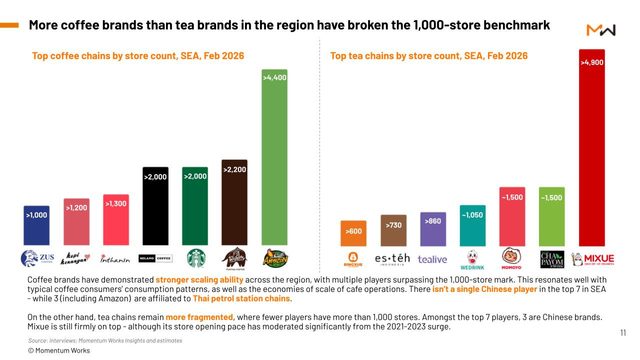
Coffee continues to lead in scalability, with more brands surpassing the 1,000-store mark across the region, supported by more standardised operations and consistent consumption patterns. Tea, by contrast, remains more fragmented, with fewer large-scale players, even as demand continues to rise.
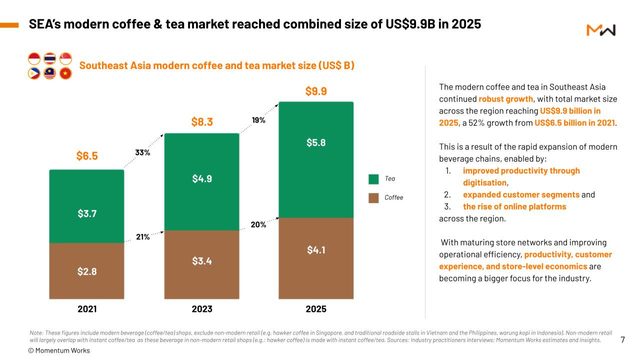
Indonesia remains the largest modern tea market in Southeast Asia, with an estimated size of about $2.46 billion in 2025, although its growth has slowed as operators rationalise after a period of rapid expansion.
Other markets are catching up quickly. Thailand, for instance, recorded the fastest tea growth at 38%, while Vietnam, Malaysia, Singapore, and the Philippines posted strong double-digit gains.
The report also notes a structural difference in positioning: coffee has long been premiumised, anchored by global brands, while tea chains are concentrated in the mass and mid-market segments, often driven by franchise-heavy expansion models.
Indonesia leads regional market
Across both categories, Indonesia remains the region’s largest market, with a combined coffee and tea market size of about $3.5 billion, followed by Thailand at $2.25 billion and Vietnam at $1.34 billion, according to the report.
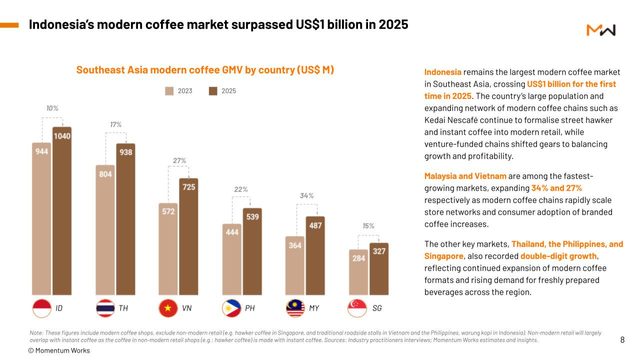
Indonesia’s modern coffee segment alone crossed $1 billion for the first time in 2025, supported by its large population and the continued formalisation of traditional coffee consumption into branded chains, such as Kedai Nescafé.
Meanwhile, Malaysia and Vietnam are among the fastest-growing markets, expanding 34% and 27%, respectively, as chains scale store networks and consumer adoption accelerates.
Chinese playbooks reshape operations
Part of the industry’s transformation has been driven by Chinese beverage brands, which are introducing highly systemised, digital-first operating models into Southeast Asia.
Southeast Asian players are increasingly adapting these approaches, the report noted.
These playbooks include app-based ordering and pre-order pickup, automated or semi-automated drink preparation, centralised supply chains, and rapid product innovation cycles.
Rather than crowding out local players, these entrants are raising the competitive bar, prompting regional chains such as Indonesia’s Kopi Kenangan and Malaysia’s Zus Coffee to adopt similar systems while maintaining localised offerings.
Beyond operations, the report highlights how digital platforms are transforming demand generation. Food delivery platforms have become a key channel, accounting for close to 30% of total order volume in markets such as Thailand, with beverages emerging as a core category.
Across the region, over 90% of beverage orders on delivery platforms are cold drinks, reflecting climate-driven consumption patterns. While smaller brands rely heavily on these platforms to scale, larger chains are increasingly building their own apps to capture customer data, drive repeat purchases, and improve lifetime value.
Scalability challenges
Even as chains expand aggressively, achieving meaningful scale remains challenging. More than 11 brands have crossed the 1,000-store mark across Southeast Asia, with eight of them originating from the region, underscoring the rise of local champions.
However, only five brands have managed to exceed 1,000 outlets within a single market, highlighting structural constraints such as market size, income levels, and franchise complexity. These are Indonesia’s Kopi Kenangan, China’s Mixue (in Indonesia and Vietnam), Vietnam’s Milano Coffee, and Thailand-based Amazon and Inthanin.
As domestic markets mature, leading Southeast Asian chains are increasingly expanding overseas to sustain growth. Kopi Kenangan and Zus Coffee are pushing into new markets across Asia and beyond, positioning themselves as regional contenders alongside global incumbents and fast-expanding Chinese players.
Southeast Asia’s beverage chain market is becoming increasingly multi-dimensional, with players no longer competing on a single axis.
Instead, they are optimising for specific value propositions such as speed, quality, price, or selection while relying on systems, data, and operational efficiency to support their positioning. Momentum Works predicts that execution at the systems level, not just expansion, will define the next generation of winners.