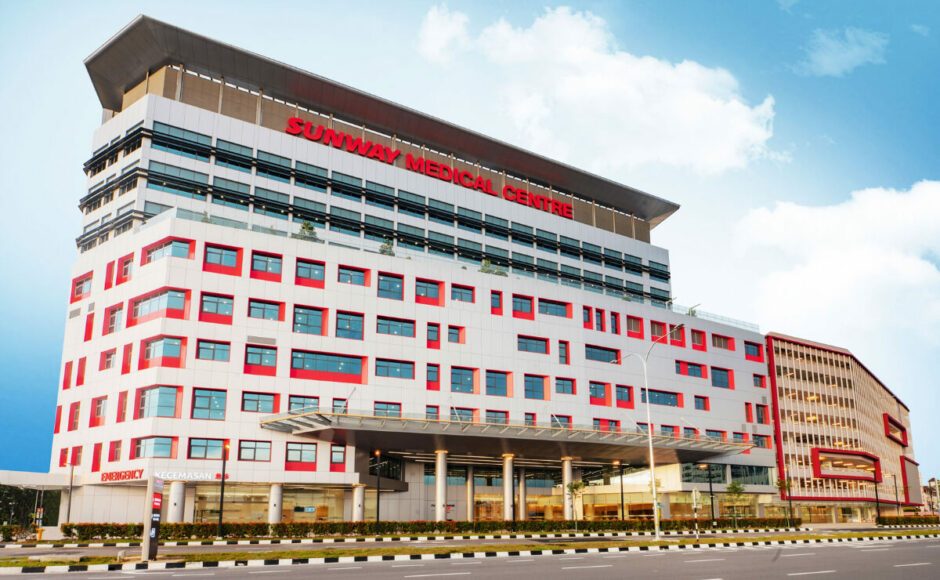
Malaysia’s Sunway Healthcare Holdings Bhd reported a 19% increase in full-year revenue as capacity expansion and patient demand lifted performance ahead of its $722 million stock market debut in what could be the country’s largest listing in almost a decade.
Revenue for the year ended Dec. 31, 2025, rose to 2.20 billion ringgit ($468 million) from 1.85 billion ringgit a year earlier, while EBITDA climbed 9% to 510.4 million ringgit ($130 million), the GIC-backed hospital operator said Monday. Profit attributable to owners was 252.2 million ringgit ($64.1 million), slightly below the 257.5 million ringgit ($65.5 million) recorded in 2024 due partly to costs from newly opened hospitals.
The IPO’s retail tranche was 5.57 times oversubscribed ahead of the company’s listing on Bursa Malaysia’s Main Market on March 18. The institutional tranche of 1.62 billion IPO shares was fully subscribed. The offering attracted 20 cornerstone investors, who took up 52.6% of the institutional shares, while the remaining shares offered through bookbuilding drew more than 11.7 billion ringgit ($3 billion) in demand.
Sunway Healthcare’s listing would be a major liquidity event for Singaporean sovereign wealth fund GIC, whose indirect unit Greenwood Capital is among the selling shareholders. GIC’s private equity department bought a 16% stake in the company for 750 million ringgit ($191 million) in a 2021 deal that valued the hospital operator at $1.1 billion.
At the IPO price of 1.45 ringgit per share, Sunway Healthcare is valued at around 30 times EV/EBITDA based on FY2026 estimates, and roughly 25 times forward FY2027 earnings, representing a premium of up to 20% versus IHH Healthcare’s listing multiple of 25–27x EV/EBITDA, though the latter currently trades at about 15x forward EV/EBITDA.
“Despite the relatively rich valuation, demand was likely supported by the scarcity of listed private hospital operators, strong visibility on capacity expansion, and high EBITDA margins in the mid-to-high 20% range, well above peers that typically operate in the low 20% range,” according to Kenanga Research’s Clement Chua. “Its licensed bed capacity is expected to grow at an 11% CAGR over the next seven years, from 1,600 beds to 3,400 beds.”
Sunway Healthcare operates a network of private hospitals anchored by Sunway Medical Centre, Sunway City in Kuala Lumpur, supported by facilities including Sunway Medical Centre Velocity, Sunway Medical Centre Penang, Sunway Medical Centre Damansara, and Sunway Medical Centre Ipoh.
Growth was driven by higher patient volumes and expanding bed capacity, with licensed beds rising 27% year-on-year to 1,777 by the end of 2025. Inpatient admissions increased 8% to 114,425, while revenue per inpatient admission rose 7% to 11,614 ringgit.
Foreign patient revenue surged 38% to 304.7 million ringgit, driven by stronger inflows from Indonesia, China and Cambodia, highlighting Malaysia’s growing role in regional medical tourism.
For the fourth quarter, revenue rose 21% year-on-year to 614.6 million ringgit, while EBITDA increased 23% to 164.7 million ringgit, supported by contributions from newly opened hospitals and stronger operating performance at established facilities.
“Our FY2025 performance demonstrates the strength of Sunway Healthcare’s integrated healthcare ecosystem and the sustained demand for high-quality private healthcare services in Malaysia,” said President Beng Long Lau.
“Even with FY2025 marking a year of rapid expansion with the opening of SMC Damansara and SMC Ipoh, the group delivered strong revenue growth by maintaining our commitment to clinical excellence and expanding our share in the medical tourism market.”
The group remains cautiously optimistic about FY2026, supported by resilient demand for private healthcare, stabilising performance at newly opened hospitals, and continued efforts to optimise capacity and efficiency. The Ministry of Health’s decision to delay the Diagnosis-Related Group system to 2027 also provides greater clarity and additional time to strengthen clinical coding and documentation capabilities.
“The recent Iranian war may indirectly affect Malaysia’s healthcare sector by disrupting global supply chains for medical-related supplies and raising costs due to geopolitical uncertainty and higher oil prices,” it said, adding that Malaysia’s diversified supply network and strong healthcare system are expected to support stable service delivery.