Southeast Asia’s food delivery market continued to expand at a double-digit pace in 2025, as winners and losers got shuffled amid growing competition and a wave of market consolidation, according to a report released on Wednesday.
In its 2025 Southeast Asia Food Delivery Platforms report, Singapore-based consultancy firm Momentum Works said the industry’s gross merchandise value (GMV) growth accelerated to 18% year-on-year, reaching $22.7 billion. This compares to a 13% growth seen in 2024 and a 5% growth in 2023.
At this rate, Southeast Asia’s food delivery platforms are fulfilling an estimated 8.5-9.5 million orders daily, almost twice the daily order volume of India, a country with roughly double the population, Momentum Works estimates.
The difference, analysts say, comes down to urban density, stronger adoption of delivery as a replacement for eating out, and platforms using affordability and discount strategies to drive demand.
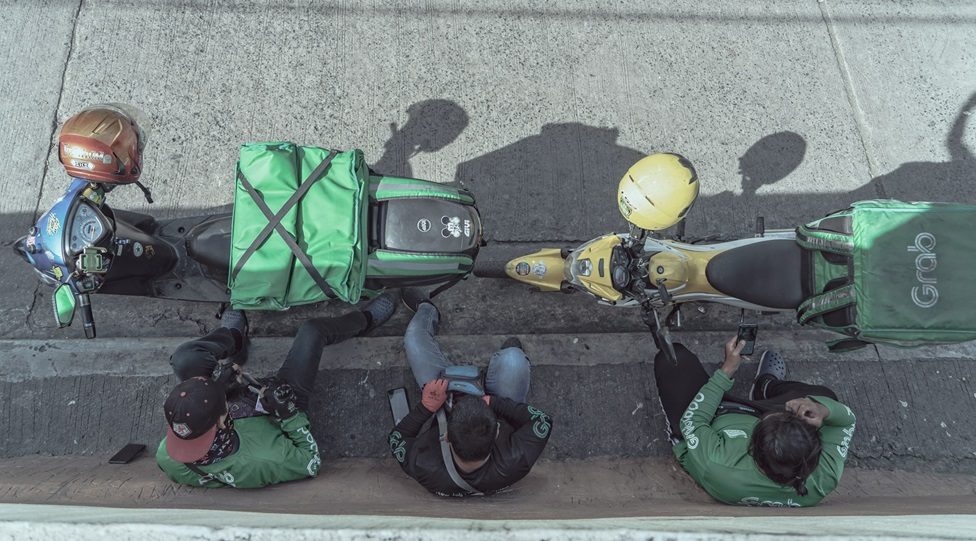
Across the six geographies covered by the report—Indonesia, Malaysia, the Philippines, Singapore, Thailand, and Vietnam—Grab continued to cement its dominance, extending its regional market share from 53.8% in 2024 to 55% in 2025.
The platform commands roughly two-thirds of the market in Malaysia, the Philippines, and Singapore, three markets of comparable size. In Thailand, Grab and Line Man now control nearly 90% of the market following Foodpanda’s exit in May 2025, while in Vietnam, Grab and ShopeeFood remain in a tight battle, collectively accounting for the vast majority of orders.
The rise of ShopeeFood also continued from 2024, when it first overtook Gojek to claim the third spot in Southeast Asia’s food delivery market. In 2025, the platform climbed another rung, surpassing Foodpanda to become the region’s second-largest player, with its market share increasing from 11.9% to 14%.
DealStreetAsia reached out to Sea Limited, but it declined to comment on its food delivery business.
Ecosystem backing drives growth
In terms of GMV, FoodPanda now ranks third, followed by Gojek, LineMan, and Deliveroo. With the rise of both Grab and ShopeeFood and FoodPanda moving to third place, it is becoming increasingly clear that market share in 2026 and beyond will hinge on ecosystem backing and expansion.
Shopee, for example, has been leveraging its delivery fleet for both food and quick commerce, including e-commerce orders. Momentum Works estimates that quick commerce accounts for roughly 40% of ShopeeFood’s delivery volume, suggesting that the platform’s fleet is largely shared between food and e-commerce fulfillment.
Momentum Works analysts also noted Grab’s cross-service utilisation, which enables the platform to drive affordability-led user acquisition while leveraging its broader ecosystem. In the app, this translates to initiatives aimed at boosting engagement and revenue across ride-hailing, grocery delivery, and dine-out services.
The report also noted FoodPanda’s internal challenges, including management turbulence in 2025 and questions around its viability as an independent player in Southeast Asia. FoodPanda, a largely standalone food delivery platform, exited Thailand in 2025, but not due to a lack of demand. Thailand, Southeast Asia’s second-largest food delivery market, recorded the highest regional growth of 22% that year, fuelled by platforms’ affordability measures, competition, and the government’s subsidy programme, the report showed.
No Grab vs Sea showdown yet
Despite ShopeeFood’s rise to the number two spot, analysts at Momentum Works say Sea is unlikely to directly challenge Grab in food delivery.
“I don’t think this is something within their strategy,” said Jianggan Li, CEO of Momentum Works. He added that ShopeeFood’s growth is driven by improving customer convenience, as Sea’s food delivery service increasingly functions as an add-on to the group’s broader ecosystem. This push comes as Shopee, Sea Limited’s e‑commerce platform, faces stiff competition from players such as TikTok Shop.
ShopeeFood currently operates in Indonesia, Vietnam, Malaysia, and Thailand but has yet to enter Singapore or the Philippines, markets where Grab has long established its dominance.
“I don’t know if they will enter Singapore, but I think for them to build something in Singapore, they will face a challenge that grab has taken so many years to resolve. How do you deal with a market where you have a high rider cost and significant offline traffic. I think it took Grab so many years to build to this day. And I think if Shopee were to join, first, I think Grab will defend against it. And second, you will probably take a while for them to learn this,” he said.
In Q3 2025, Grab’s delivery segment grew 26% in GMV to $3.7 billion, with revenue rising from $380 million in Q3 2024 to $465 million in the third quarter of 2025.