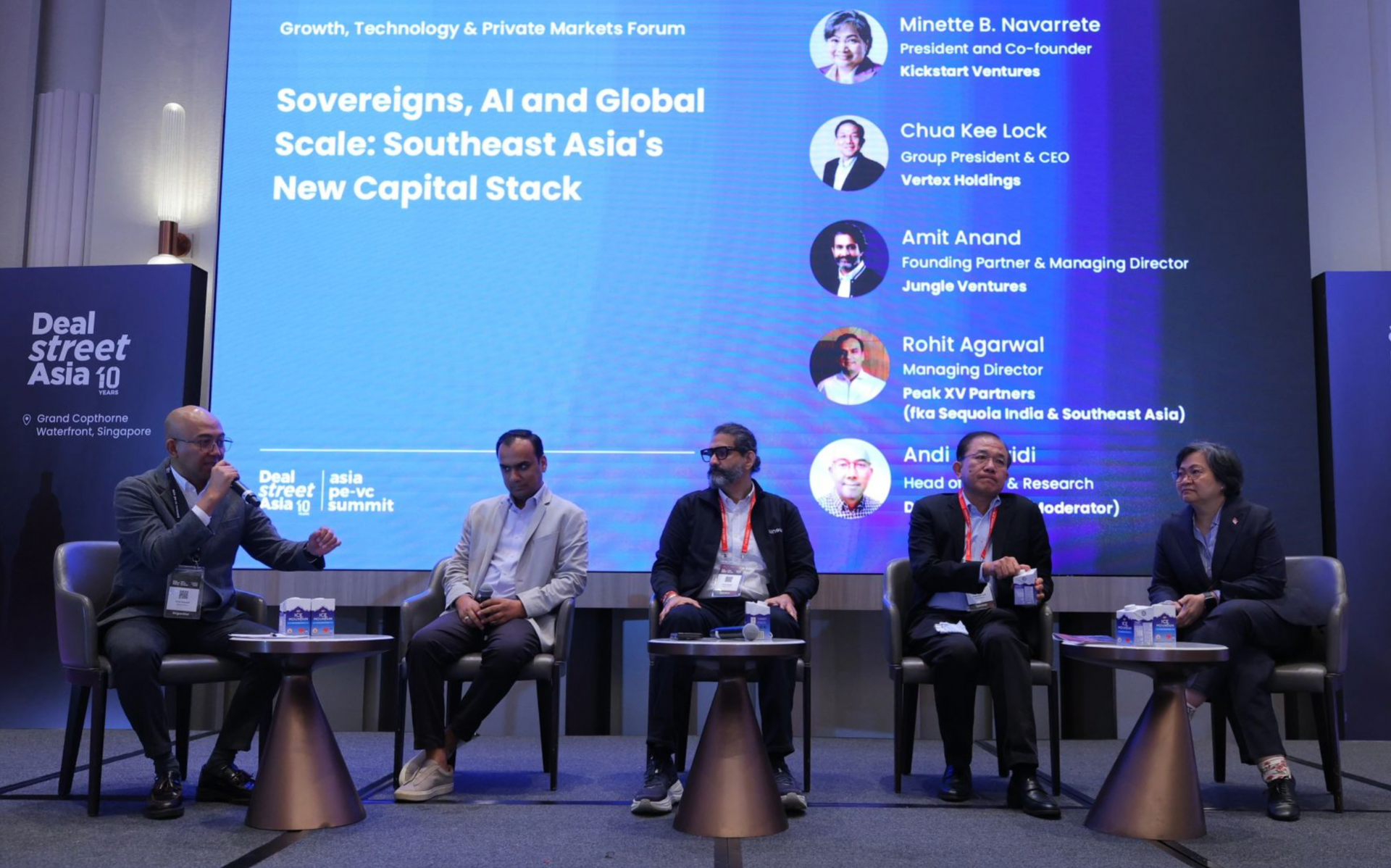
Southeast Asia’s venture capital market is contending with a structural gap in follow-on funding, even as headline funding values show signs of recovery driven by a handful of mega-deals, investors said at DealStreetAsia’s Asia PE-VC Summit in Singapore.
Senior executives from Vertex Holdings, Peak XV Partners, Jungle Ventures, and Kickstart Ventures said the market is settling into a structurally smaller, more disciplined cycle after the 2020-22 capital overshoot.
The panellists were reacting to a report by Kickstart Ventures and DealStreetAsia—Southeast Asia Startup Funding: Half Year 2026—that shows venture capital funding for Southeast Asian startups jumped to $7.25 billion across 217 deals in the first half of 2026, up from $3.5 billion in H2 2025.
However, total transactions fell 7% to a multi-year low, with the recovery driven largely by a single $4.5 billion Series C round for Singapore-based DayOne. Excluding DayOne, regional funding fell 21% half-on-half to $2.75 billion.
Singapore dominated the landscape, drawing $6.65 billion across 145 deals to capture nearly 92% of total equity funding. Stripping out DayOne, the city-state still commanded 78% of regional capital.
Series A funding slumped, with median deal sizes dropping to $8 million from $11.6 million in late 2025, creating a potential bottleneck for startups seeking mid-stage scale-up capital.
The numbers signal selective investor appetite rather than a broad market rebound.
“Selectivity is the nature of investing,” said Minette Navarrete, managing partner and founder of Kickstart Ventures. But she cautioned that selectivity should not become “monocultures”, saying Southeast Asia benefits from investors with different approaches and risk profiles.
Navarrete said the shortage of follow-on capital did not always mean a company lacked commercial value. Kickstart backed one company in 2016 but did not write its next cheque until 2025 because the business was profitable and generating strong revenue.
The company was generating billions of pesos annually in revenue for one of Kickstart’s limited partners, she said, though the long gap between investments meant the fund could not mark up the investment during that period.
Vertex Holdings Group president and CEO Chua Kee Lock described the growth funding environment as a “major ecosystem breakdown,” pointing to a hollowed-out middle stage where promising, revenue-generating regional companies struggle to source follow-on capital locally.
“Not only has the early-stage VC market dropped significantly, but that whole middle layer of this stage is essentially hollow,” Chua said, adding that regional firms often have to look as far as Japan, Hong Kong, or mainland China to find growth co-investors.
The shortage of growth capital is further exacerbated by a lack of viable public listing venues in the region.
Panelists highlighted that startups that raised capital at $1 billion unicorn valuations in recent years now face changed market metrics, leaving them stuck without an obvious exchange to execute an initial public offering.
Jungle Ventures founding partner Amit Anand said it will take two to three years for the current cohort of 15 to 20 high-quality, profitable startups in Southeast Asia to go public and unlock distributions for institutional investors, drawing parallels to India’s venture maturity cycle.
“I don’t think [the shortage of follow-on funding] is going to get solved in a short period,” Anand said. “As we get to that inflection point [of public listings], I’m very confident the ecosystem will come back to its vibrancy… but my calculation is it is going to take at least two to three years more.”
Peak XV Partners managing director Rohit Agarwal emphasised that while cross-border listings offer short-term options, Southeast Asia ultimately requires a credible, local public market ecosystem built specifically for digital technology businesses.
“IPOs remain the only predictable path where if you build a good business, valuation aside, you can take it public,” Agarwal said. “You need a predictable capital base raised around the strategy of focusing on digital businesses in the region.”
The panellists also cautioned against a rush into artificial intelligence, saying Southeast Asian investors should focus on specific commercial applications and local problems rather than attempt to replicate capital-intensive U.S. AI models.
Agarwal said AI companies could be particularly difficult to assess because many are pursuing novel technologies without established comparable companies.
“If you wanted to start in Southeast Asia today, and look at diligence, etc., I think the majority of companies in AI, you cannot really diligence because they are often building very innovation-oriented businesses,” Agarwal said.
Read the Southeast Asia Startup Funding: Half Year 2026 report for:
- Quarterly, half-yearly, and annual startup fundraising trends in SE Asia
- Top deals of H1 2026
- Most favoured industries by venture investors
- Fundraising trends by country
- Trends in climate tech funding
- Insights from prominent founders and fund managers.