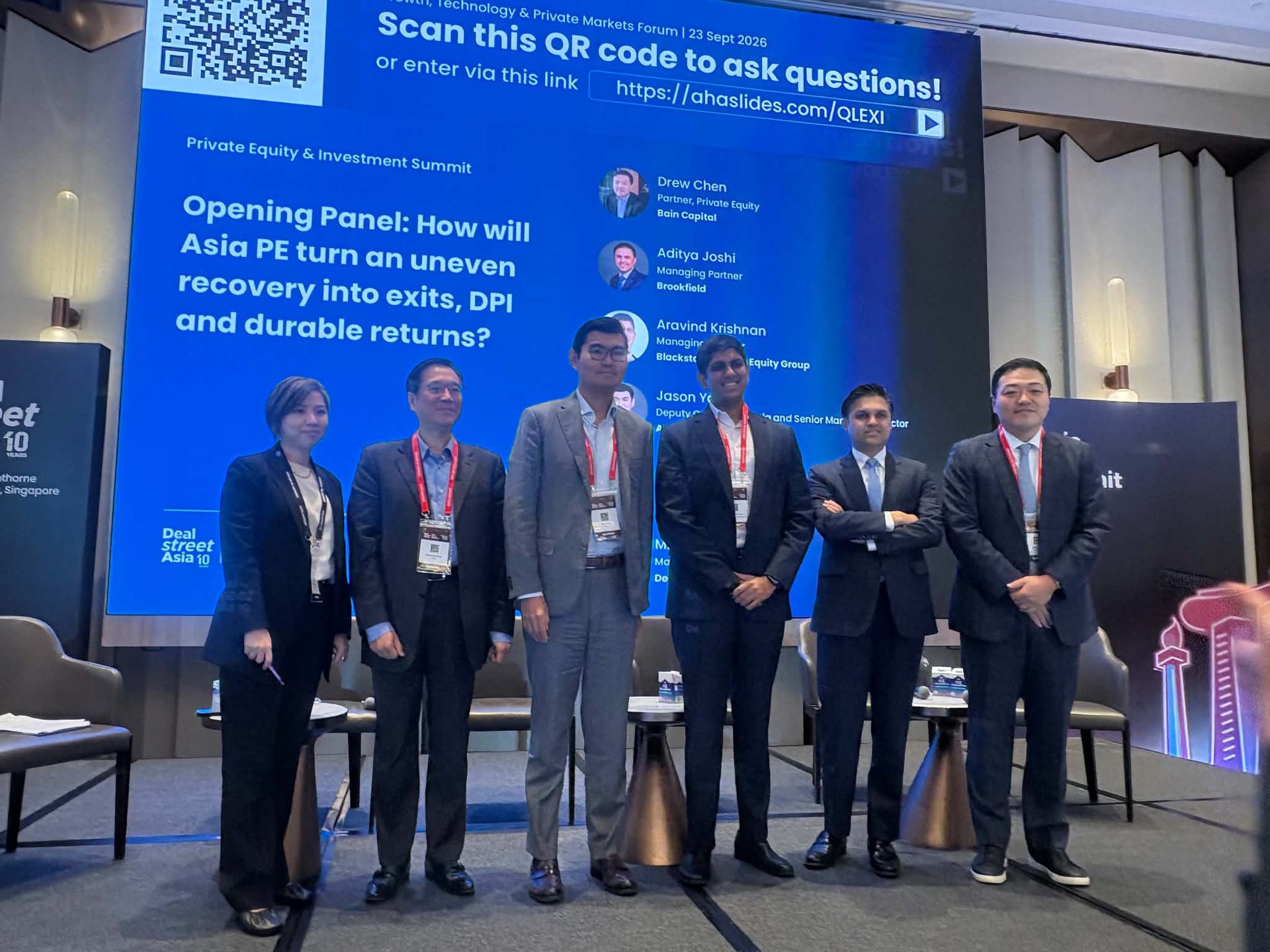
The private equity exit environment in Asia is increasingly bifurcated across sectors and markets, prompting fund managers to evaluate exit routes, operational improvements, and liquidity strategies much earlier in the investment cycle, executives said at the Asia PE-VC Summit 2026 in Singapore on Wednesday.
The focus on exits reflects growing pressure from limited partners to convert portfolio value into cash distributions.
Speaking during a panel discussion titled ‘How will Asia PE turn an uneven recovery into exits, DPI and durable returns?’, Drew Chen, a partner at Bain Capital‘s private equity business, said investor interest remained strong in selected sectors while exits had become more difficult in areas that had fallen out of favour.
“It’s a little bit similar to what people talk about as K-shaped,” Chen said, adding that strategic sectors were attracting robust investor interest while consumer sectors could require more patience.
Bain last year sold a Chinese data centre platform to a strategic buyer for about $5 billion, in what Chen described as probably the largest private equity exit in China in five years. The firm also exited Kyosha in Japan, citing the strength of the memory market.
Brookfield‘s Asia-Pacific private equity head Aditya Joshi noted that the firm’s investment teams are already considering the exit strategy from the time an asset is acquired.
Deal teams are required to identify potential buyers and determine what needs to be done over the holding period to make an asset attractive to strategic buyers, other sponsors or public markets, he said.
Blackstone‘s Aravind Krishnan pointed to how the firm retains greater flexibility over exits through its control investments in Asia.
Blackstone seeks multiple potential exit routes for each investment and has returned about $6 billion of equity from Asia over the past two years through IPOs, block sales, strategic sales and recapitalisations.
The firm’s ability to shift capital among Asian markets has also become important as valuations and exit conditions diverge across countries and sectors, Krishnan added.
At the same time, operational value creation has become increasingly important as private equity firms are no longer able to rely primarily on rising valuations to drive returns.
Earnings growth and free cash flow generation accounted for more than two-thirds of the firm’s historical returns, with technology transformation increasingly central to its strategy.
Krishnan cited Sona Comstar, an Indian auto-components company that Blackstone transformed from a supplier focused on internal combustion engines into an electric vehicle components business before taking it public.
Brookfield has similarly narrowed its focus to sectors and markets where it has established operational capabilities.
The firm has been applying artificial intelligence to areas such as production planning, procurement, and supply chains, particularly in industrial businesses.
Separately, Bain’s Chen said the firm’s technology strategy was increasingly focused on identifying bottlenecks ahead of broader market recognition, particularly in areas such as memory, optical components and data centres.
“The key for us is if we’re going to try to play the cycle, we need to make sure we truly understand the cycle,” Chen said.
He said timing the exit was equally important, with firms needing to avoid holding assets too long after a cycle had peaked.
He added that the decision to hold an asset should be treated as a new investment decision, based on whether the business can still generate the required return.
Bain underwrites investments to a 25% internal rate of return on exit, he said, adding that the firm recently sold a large Australian investment to an infrastructure fund after bids reached a level where the potential return from continuing to hold the asset no longer justified remaining invested.
Ripe for secondaries
As a liquidity solution, Asia’s secondary private equity market remains small despite the region’s large underlying private capital market, said Jason Yao, deputy co-head of Asia and senior managing director at Ardian.
Secondaries account for only about 2% to 3% of global secondary activity even though Asia represents roughly 15% to 20% of global private equity, Yao said.
He said activity in GP-led continuation vehicles was beginning to increase as the gap between buyers’ and sellers’ price expectations narrowed.
Asia’s secondary market has also benefited from stronger demand from global secondary investors, pensions and insurers, while sellers are becoming more willing to accept discounts to secure liquidity, Yao said.
Hybrid solutions
Private credit is also seeing increased demand for dividend recapitalisations, NAV financing, and hybrid solutions for private equity sponsors and funds, said Raymond Chan, managing director and head of Asia-Pacific credit at CPP Investments.
Chan said Asian credit remained dominated by banks, while companies with resilient cash flows, healthy balance sheets, and strong pricing power were continuing to perform better than highly leveraged businesses.
He highlighted the mismatch between predominantly short-term bank funding and longer-term projects as a particular vulnerability in Asia, alongside reliance on banks and risks associated with private wealth capital.