Indonesia’s consumer market is not slowing uniformly; it is fragmenting. While household spending faces pressure and capital has become more selective, founders and investors say growth remains accessible for companies that can execute with precision, manage costs, and use technology as infrastructure rather than spectacle.
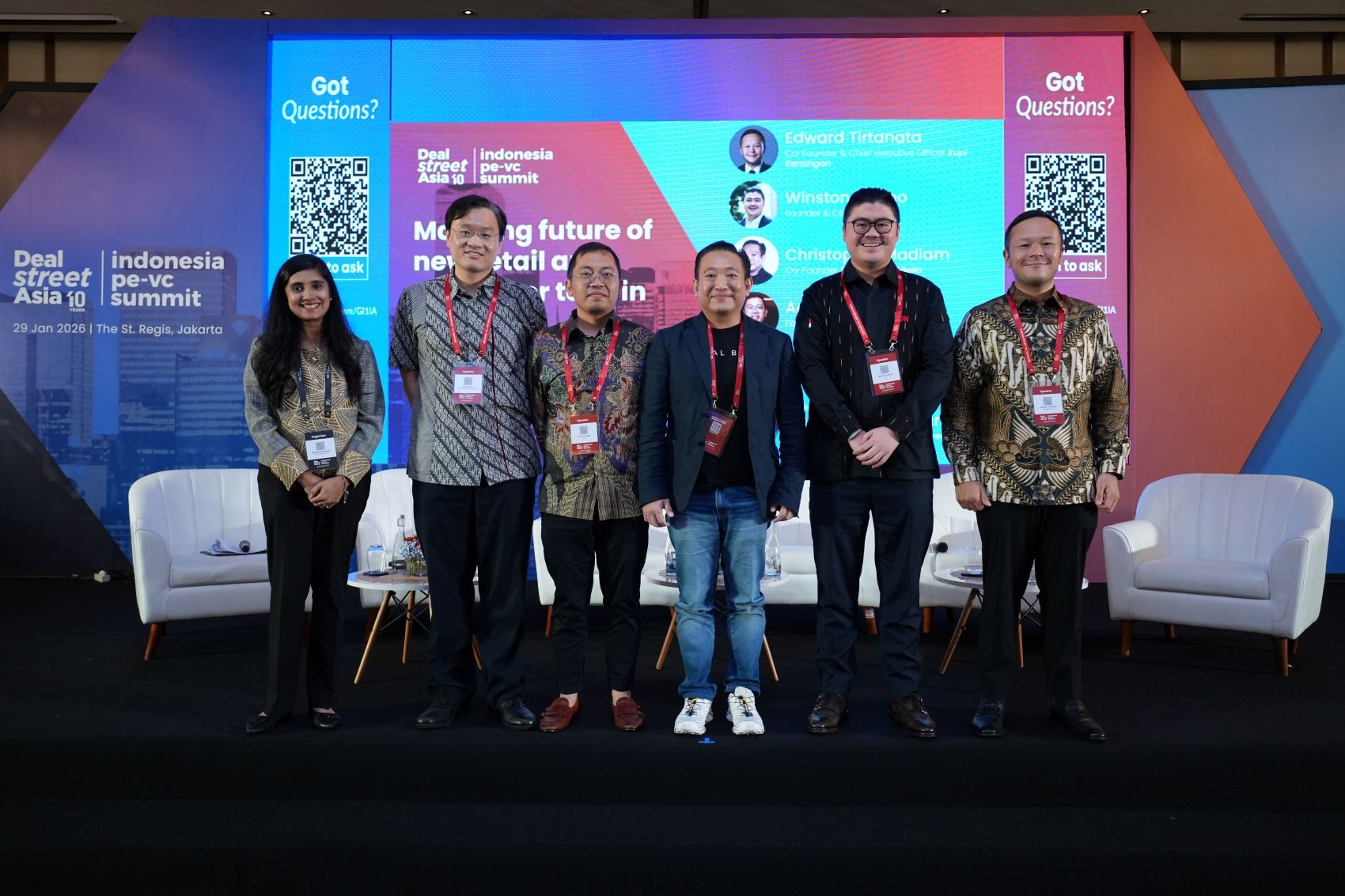
That recalibration was the dominant theme at the ‘Mapping the future of new retail and consumer tech in Indonesia‘ panel at DealStreetAsia’s Indonesia PE-VC Summit 2026 in Jakarta last week.
The panel—at Jakarta’s St. Regis on Jan. 29—brought together leaders from food & beverages, media, beauty, venture capital, and global private equity—Edward Tirtanata, co-founder & CEO of Kopi Kenangan; Winston Utomo, founder & CEO of IDN; Christopher Madiam, co-founder & CEO of Social Bella; Achmad Zaky, founding partner of Init-6; and Carlson Lau, managing director of Ares Management Corporation.
Despite operating across different verticals, panellists converged on one conclusion: the era of growth fuelled primarily by pricing power and capital abundance has ended. What replaces it is a more disciplined, execution-led phase of consumer expansion.
Pricing power has become local
For consumer operators, pricing pressure is real, but uneven. Kopi Kenangan’s Edward Tirtanata said performance now varies sharply by geography, forcing companies to abandon one-size-fits-all strategies. “In Indonesia, pricing is not across the board,” he said. “There are areas where you can charge more, and there are areas where you cannot. You need to be very mindful and very reactive to whichever city or area you are in.”
Despite broader concerns around weaker consumption, Tirtanata said the company continued to post double-digit same-store sales growth, driven less by aggressive pricing and more by structural cost improvements. Technology, he argued, has quietly reshaped the unit economics of consumer businesses.
For consumer operators, pricing pressure is real, but uneven.
“Tech in Indonesia has become much more sustainable,” he said. “It’s a lot cheaper. The age of burning money is over.”
Lower customer acquisition costs—particularly on digital advertising platforms—have allowed Kopi Kenangan to scale user growth while keeping expenses in check. “Our customer acquisition cost went down significantly compared to 2023,” he said, adding that this enabled the company to acquire millions of new users without resorting to heavy discounting.
Kopi Kenangan acquired 4.5 million new consumers and opened 347 new stores throughout 2025. At the group level, the company operates 1,324 stores across six countries. Indonesia is the largest market with 1.136 stores, followed by Malaysia with 158.
Advertising follows sentiment, not fundamentals
In the media sector, the pressure has been cyclical rather than structural. IDN’s Winston Utomo said advertising demand has remained intact but is highly sensitive to confidence levels among brands. “Advertising is a perception-driven business,” Utomo said. “If people feel optimistic, they will spend more. If they feel pessimistic, they will reduce spending.”
He noted that advertising slowed in the first half of last year as sentiment turned cautious, prompting IDN to adjust pricing temporarily. “In Q1 and Q2, we reduced pricing a bit to attract more clients,” he said. “In Q3 and Q4, confidence increased, and spending came back.”
More recently, demand has picked up again. “In the past three weeks, we’ve seen a spike in brands wanting to advertise with us,” Utomo said. The implication for investors, he added, is that volatility in ad revenue should not be confused with deteriorating fundamentals.
In beauty, trust matters more than price
For Social Bella, the parent company of beauty retailer Sociolla, Christopher Madiam explained that the influx of low-cost global products into Indonesia has not undermined the beauty sector but it has raised the cost of weak differentiation.
“Low price is always good for the consumer,” Madiam said. “But low pricing is not going to break the industry. It’s going to break low differentiation.”
Beauty, he argued, behaves differently from discretionary categories. While consumers may become more selective during uncertain periods, they do not abandon trusted products. “They have less ability to experiment,” he said. “But for the product they already trust, they will still go for it, regardless of pricing.”
This dynamic reinforces the importance of ecosystem-building over transactional sales. “For us, capital is not a milestone,” Madiam said. “It’s just a tool to grow further.”
He added that recent fundraising activity was weighted toward secondary transactions, reflecting the company’s ability to fund expansion internally. “The company thankfully doesn’t need a lot of capital for expansion,” he said, describing fundraising as “optionality, not a destination”.
Social Bella recently welcomed US growth investor General Atlantic as its largest shareholder, paving the way for the full exit of early backers Pavilion Capital and L Catterton. East Ventures’ EV Growth, EDBI, and Temasek partially sold their stakes. Based on the company’s regulatory filings, Social Bella issued new ordinary and preference shares totalling $70.6 million, as first reported by DealStreetAsia.
Investors reset expectations: profitability first
From an investor’s perspective, Achmad Zaky, founding partner at Init-6 and founder of Bukalapak, said expectations have fundamentally shifted.
“Back then, investors were happy with 60 times or 90 times growth, even if you burned a lot of money,” he said. “You will never find investors like that anymore.”
Today, Zaky said, funds are prioritising profitability and sustainable growth—even if expansion is slower. “If you are profitable and you grow two times or three times, that’s good,” he said. “Sometimes even 50% is good.”
He also stressed that retention has overtaken acquisition as the hardest problem for consumer startups. “Acquisition is simple—you need money and ads,” he said. “Retention is the core value of a company. That’s the toughest job.”
Zaky warned that founders often underestimate this challenge. “Build a great product, do research—that’s more important than acquisition,” he said.
Consumer companies are starting to look like tech firms
Carlson Lau, managing director at Ares Management Corporation, said one of the biggest shifts over the past five years is how investors now define ‘tech’.
“A lot of these consumer companies at the core actually behave like internet businesses,” Lau said. “The way they think about data, customer segmentation, product development—it’s extremely mature.”
He cited examples of consumer companies using real-time dashboards to track purchases across offline networks, automatically adjusting demand forecasts and procurement. “This is next level in how they think about retail,” he said.
As a result, Ares is increasingly focused on consumer businesses that combine physical products with “internet elements”. “We continue to work on this strategy,” Lau said.
He highlighted general trade as a particularly compelling area. “It’s super fragmented and very difficult to execute,” he said. “But that’s exactly why we think it’s interesting.”
AI as infrastructure, not a front-end feature
Across the panel, artificial intelligence was discussed less as a headline feature and more as a background capability. Madiam cautioned against using AI as a visible interface.
“If your customer can feel that there is AI, maybe your AI is not working very well,” he said. Instead, he argued, AI should quietly help consumers make fewer wrong decisions and improve their experience without friction.
Lau echoed the view, noting that AI-driven tools are increasingly used to track shifting consumer preferences in real time. “Customer trends always move,” he said. “The need to continuously innovate is super important.”
Taken together, the panel discussion pointed to a consumer market that is becoming more disciplined rather than diminished. Growth remains available, but it now rewards companies that combine operational rigour, data-driven execution, and capital efficiency, which takes the market to maturity. And in this next phase, technology is no longer the headline but simply a requirement for entry.