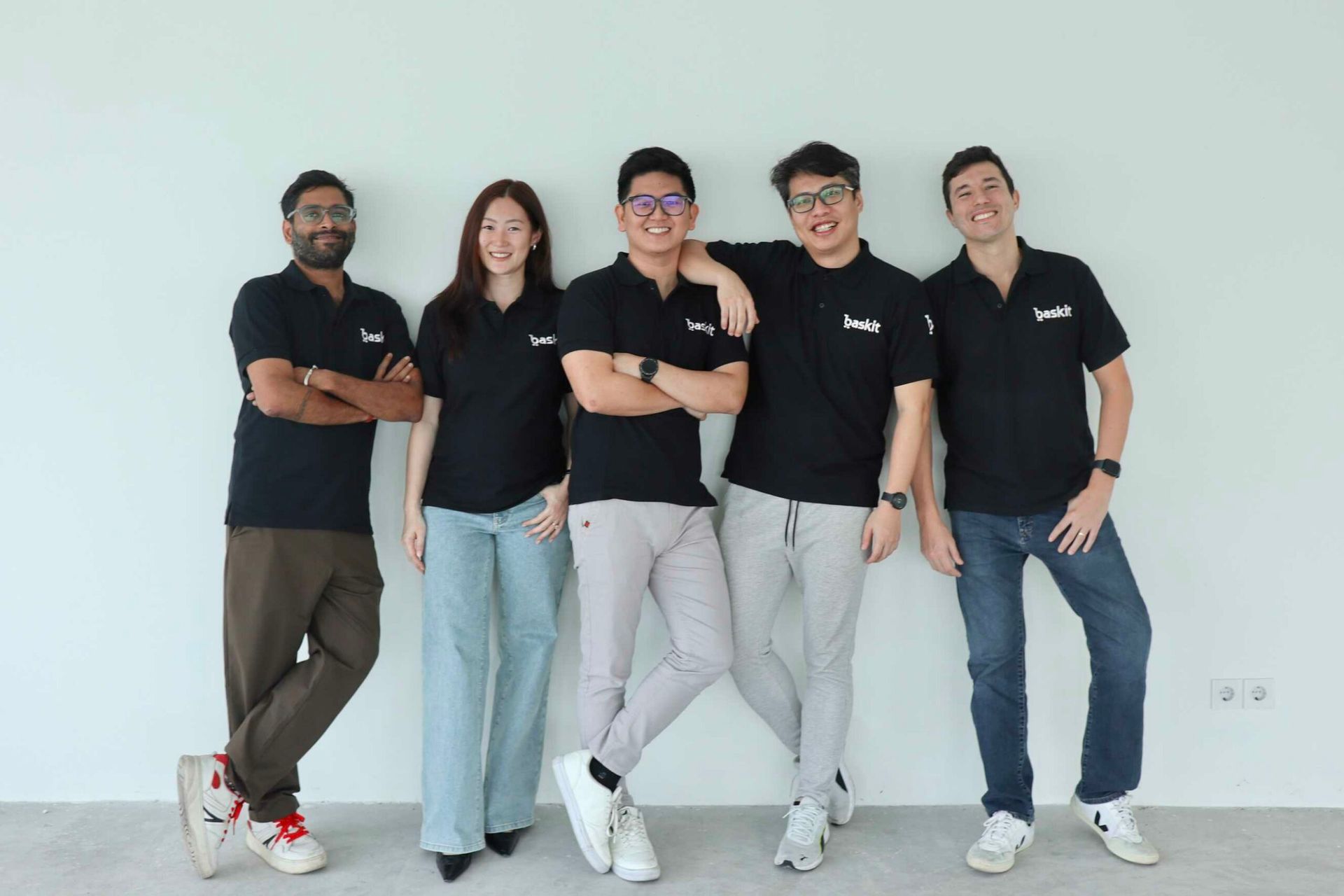
Indonesia-based distribution enablement startup Baskit has raised $4.4 million in the first close of its Series A round led by Cento Ventures, according to an announcement on Wednesday.
The round included Kaya Founders, Analog Ventures (previously Forge Ventures), and Orvel Ventures, alongside a $3-million revolving credit facility from HSBC Innovation Banking. The latest raise brings Baskit’s total equity funding to $9.9 million, following its $5.5-million pre-seed and seed rounds in 2023.
The funding round, which brings a mix of global, regional, and local strategic partners, will support Baskit’s expansion plan into the Philippines—its first market outside Indonesia—in the second half of this year, CEO Yann Schuermans told DealStreetAsia in an interview.
Baskit is building an AI-enabled platform that combines software, operational workflows, payments, and embedded credit to help brands scale across fragmented offline distribution networks. It currently works with more than 60 brands and retail partners, including Alfamart, Circle K, and Boots.
From execution layer to infrastructure
While Baskit initially focused on digitising parts of the distribution process, it has evolved into a broader platform that supports brands in designing and executing go-to-market strategies while coordinating with supply-chain players across the ecosystem.
Rather than owning inventory, Baskit orchestrates distribution by connecting brands with logistics providers, distributors, and retail channels while embedding financial services to improve liquidity across the chain.
A key component of its model is the integration of payments and credit, enabling distributors to access working capital for inventory. The company works with financial institutions such as HSBC and payment networks like Visa to facilitate transactions and treasury flows across its ecosystem.
“We don’t disrupt, we enable [..] The idea has always been to bring together the existing players in the ecosystem—not to cut them out,” Schuermans said.
Neil Falconer, Head of Innovation Banking of HSBC Singapore, said, “HSBC Innovation Banking is proud to support high-growth businesses like Baskit with tailored financing solutions from our $1.5-billion funding pool [..] We’re excited to support Baskit’s Southeast Asia expansion.”
Baskit is increasingly focusing on small and mid-sized brands—particularly in FMCG, beauty, and personal care—that lack the resources to build offline distribution at scale.
“Our priority is the long tail of brands,” said Schuermans. “These are companies that don’t have the capabilities of large incumbents but still need access to distribution.”
In Southeast Asia, more than 90% of trade still flows through offline channels. For many emerging brands, building reliable distribution at scale remains a complex and resource-intensive challenge.
Profitability & capital discipline
Baskit said it has been consistently profitable for the past 1.5 years, supported by strong margins and balanced cash flows. The company operates an asset-light model and reports double-digit contribution margins while maintaining profitability at the net operating level.
Schuermans said it intends to maintain profitability even as it scales. “If we want to accelerate, we reinvest profits,” he said. “We’re not going back to being a loss-making company just to grow.”
Investors said this discipline was a key factor behind the deal.
“Baskit has spent years mastering one of the most complex operating environments in Southeast Asia: offline distribution in fragmented growth markets,” said Yuan Lee Chung, Partner at Cento Ventures.
“We believe Baskit is helping define a new playbook for Southeast Asian technology—one built on operational depth, capital discipline, and the confidence to solve hard problems in the real economy.”
Baskit marks Cento’s third investment in Indonesia, after Finfra and Monit.
Philippines expansion next
Baskit plans to enter the Philippines as its first market outside Indonesia, citing similarities in market structure, including fragmented distribution networks and continued reliance on offline channels.
“The same fundamental problems exist,” Schuermans said. “What took us time to build in Indonesia, we can replicate faster with the learnings we have.”
The company expects to deploy a relatively lean model, though execution will depend heavily on local hiring and partnerships.
Paulo Campos, Founding Partner at Kaya, added: “The Philippines remains, at its core, a consumer story—one where commerce continues to evolve alongside a rapidly shifting middle class. While e-commerce unlocked the first wave of growth, we are now seeing a natural progression towards omnichannel, as brands need to meet consumers seamlessly across both online and offline touchpoints.”
“Kaya Founders is excited to partner with Baskit at this inflection point, as digital-first brands look to expand into offline channels to unlock their next phase of growth. By pairing strong operational fundamentals with a robust distribution network, Baskit enables brands to bridge this gap and scale more effectively. In doing so, it captures what we believe defines the next phase of the New Filipino Consumer—one shaped not by channel, but by access, convenience, and consistency across experiences.”
Positioned alongside, not against incumbents
Baskit positions itself as a partner to existing supply-chain players rather than a direct competitor, particularly in markets where traditional distribution networks remain dominant.
However, as the company scales, it may increasingly overlap with larger distributor platforms.
At the same time, it sees opportunities to collaborate with established retailers and distributors, especially in markets like the Philippines, where large chains play a significant role.
“The challenge of building offline distribution at scale is universal,” Schuermans said. “It’s not unique to Indonesia or the Philippines—it exists across markets.”
By combining technology, operations, and financial services, Baskit is positioning itself as a foundational layer for brands expanding across Southeast Asia’s offline markets.