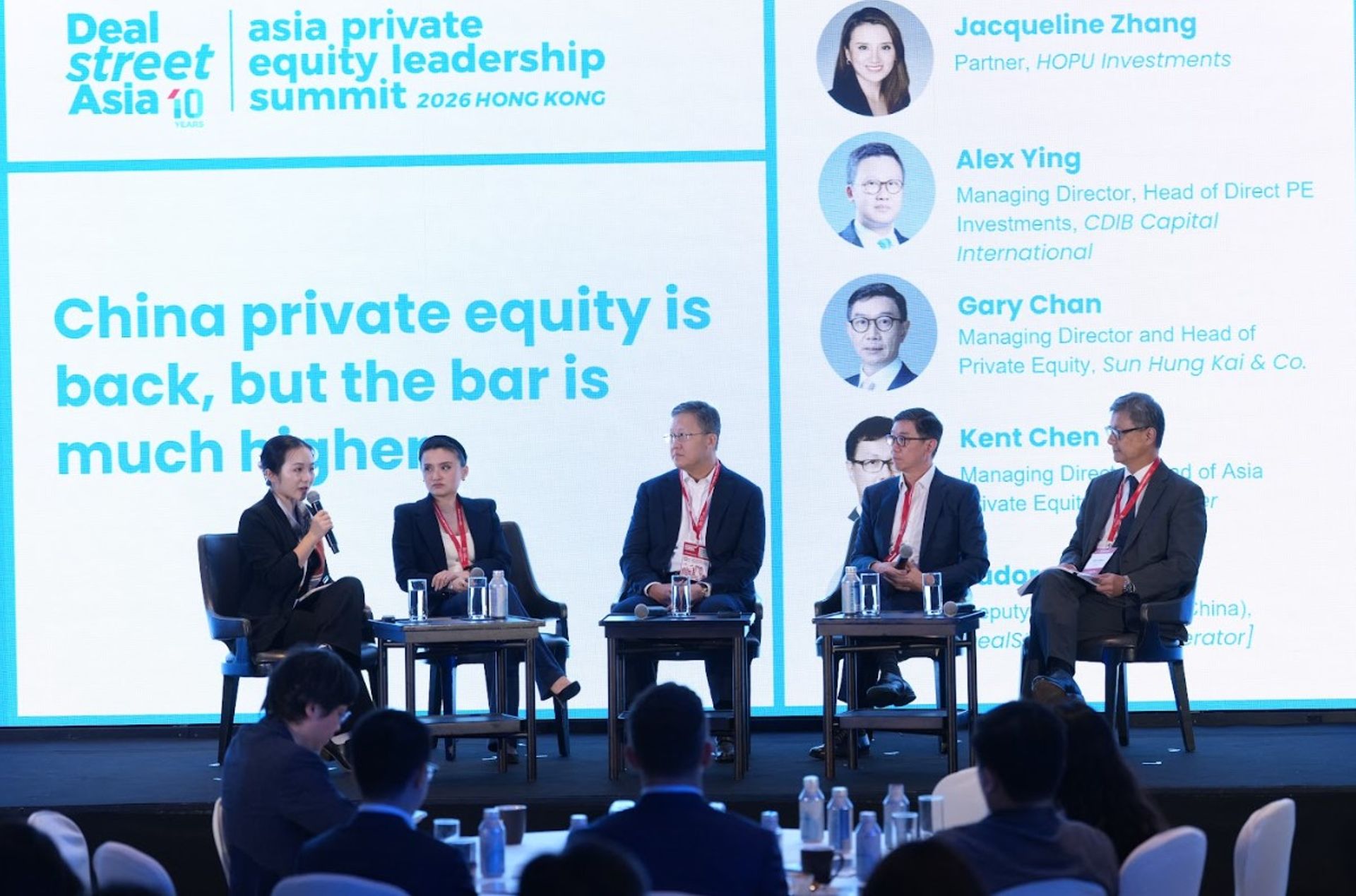
China’s private equity is drawing renewed investor interest after several difficult years, but managers face a higher bar on exits, distributions, and value creation before global limited partners return in force, panellists said at DealStreetAsia’s inaugural Asia Private Equity Leadership Summit in Hong Kong on Wednesday.
Speaking at a session titled “China private equity is back, but the bar is much higher”, investors said capital is returning only selectively, with LPs prioritising managers that can show realised returns rather than rely on valuation marks or sector narratives.
“We are seeing a lot more Chinese GPs,” said Gary Chan, Managing Director and Head of Private Equity at Sun Hung Kai & Co. “But I would say it’s very selective.”
Chan said GP-led secondaries are becoming a more common liquidity tool in China, but investors need to determine whether assets are genuinely worth holding for longer or are unable to secure a traditional exit.
“Indeed, there are situations where the underlying asset is very, very good. And the GP wants to hold onto it for a lot longer.”
Kent Chen, Managing Director and Head of Asia Private Equity at Neuberger Berman, said China remains attractive after a valuation reset following years of pressure from trade tensions, COVID-19, policy shifts, and geopolitical uncertainty.
“China’s economy has gone through basically all sorts of stress tests that you can imagine. From a valuation point of view, this is still an attractive moment to look at China.”
Chen said investors should also look beyond AI and robotics to China’s services sector, which remains smaller as a share of GDP compared with developed markets.
He also cautioned against requiring every GP or portfolio company to have an AI angle, saying investors should assess whether the technology can materially improve a business.
Alex Ying, Managing Director and Head of Direct PE Investments at CDIB Capital International, said LPs still need to see more exits and full deal returns after a painful period for China-focused funds.
“I think people would like to see a bit more exits, full deal returns. What it has gone through the last 3-4 years has been quite painful,” Ying said.
He said the tougher environment could benefit disciplined managers with differentiated strategies and clearer reasons for owning specific assets.
“It’s getting more difficult rather than easier. I see it as not so much as a headwind, but a moat for the folks that know what they’re doing.”
CDIB Capital International is focused on advanced manufacturing businesses, including companies facing ownership transitions, Ying said. “We look at boring businesses,” he said. “Within advanced manufacturing, there are tonnes of opportunities.”
Jacqueline Zhang, Partner at HOPU Investments, said returning capital remains the strongest argument for raising fresh money, adding that LPs are more likely to recommit when managers first return cash.
She said China is beginning to produce more traditional private equity opportunities, including control deals, succession situations, and carve-outs.
“Maybe for the first time in a long time, you will see real classic PE deals come out of China.”
Zhang said HOPU is also seeing opportunities in more complex situations, including carve-outs and “orphan assets” owned by Chinese companies, where investors can structure deals rather than compete in crowded auctions.
“You need to lean into more complicated situations to create more variety of deals,” she noted.
Liquidity remains one of the biggest constraints for China-focused funds.
Neuberger Berman’s Chen said industry participants have spent years lobbying Hong Kong authorities to allow private equity managers to list their vehicles on the Hong Kong Stock Exchange, a move he said could help create liquidity without forcing asset sales and broaden the LP base.
Speakers also pointed to advanced manufacturing, robotics, biotech, healthcare, green energy, and services as areas where China could continue to produce globally competitive companies.
Sun Hung Kai & Co’s Chan said investors are willing to pay high valuations for potential global champions, but only where those valuations are supported by revenue and profitability.