Asia’s private equity secondary market is approaching an inflection point, as maturing portfolios, weak distributions, and rising demand for liquidity drive more activity.
Executives at DealStreetAsia’s inaugural Asia Private Equity Leadership Summit in Hong Kong on Wednesday said currently, Asia only accounts for low single-digit percentages of global LP-led and GP-led secondary transaction volumes, despite representing a far larger share of global private equity assets under management.
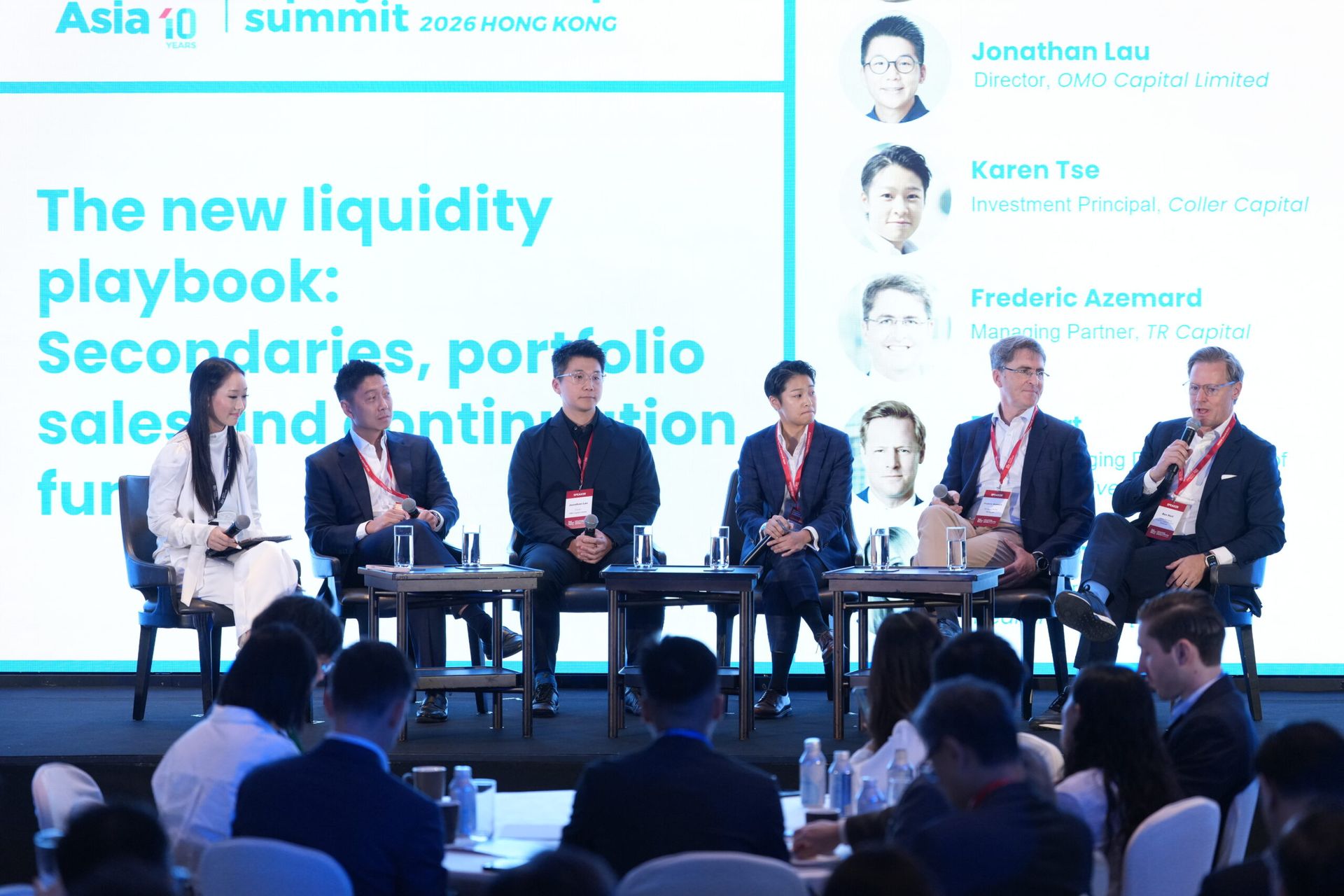
Speaking during the session titled “The new liquidity playbook: Secondaries, portfolio sales and continuation deals”, panellists from Evercore, Coller Capital, TR Capital, Partners Group, and OMO Capital Limited said many Asian institutional investors are now transitioning from years of aggressively building private equity allocations into a phase of actively managing portfolios, creating more demand for secondary transactions.
“When you are a new LP, you are in active allocation mode, you’re thinking about buying, not selling. But as those programmes reach target allocation, there’s a shift in your approach from active allocation to active management,” said Ben Hart, Head of APAC Private Capital Advisory at Evercore.
This shift, however, is expected to play out gradually.
“I think it’s a very interesting time for secondaries. If you look at 2020, $160 billion of secondary volume… and that was a record year, and now we are way past that, we’re over $200 billion,” said Martin Liew, Managing Director, Private Equity, Asia-Pacific, Partners Group.
“What we do feel will take some time to get up there is Asia as part of the overall segment, so it’s 3% today. But we are in a growing market. How long it actually takes to get to that 10% is probably going to take a little bit more time,” Liew added.
On the GP side, Karen Tse, Investment Principal at Coller Capital, said more Asian fund managers are beginning to explore GP-led secondaries as fundraising slows and aging portfolios face a tougher exit environment.
“If you look at the historical fundraising cycle, around 2017-20 was probably the peak fundraising market in Asia,” Tse said. “If you’re a manager, your funds are approaching a five- to eight-year horizon, coupled with a difficult exit environment, low DPI. It’s time to think about how to optimise my existing portfolio, so then I can deliver the DPI that LPs are looking for.”
Jonathan Lau, director of OMO Capital, said uncertainty surrounding technology valuations and AI disruption has also started affecting transaction activity in parts of the market.
“I think the biggest war that we’ve seen that has an impact on the secondary market is really the war on enterprise software, and that’s had a huge impact on a lot of sellers delaying bringing software portfolios and private credit to market,” Lau said.
Frédéric Azemard, Managing Partner at TR Capital, said geopolitical uncertainty and ongoing conflict are beginning to affect seller behaviour and pricing expectations across Asia’s secondaries market.
“What we’ve seen across the region, China and India, is that the war is probably pushing a few people that were just on the edge of saying, ‘Okay, shall we sell or should we sell,’ to now say, ‘Okay, too much uncertainty,’” Azemard said.
He added that buyers are also becoming more cautious in evaluating assets amid uncertainty around raw materials and broader macro conditions.
Despite geopolitical uncertainty and softer M&A activity globally, panellists broadly said they expect secondary deal activity in Asia to continue accelerating over the next few years as more regional LPs and GPs turn to portfolio management and liquidity solutions.