Malaysia has become a playground for global technology giants.
With roughly 36 million people and a $472-billion economy, the country has neither Indonesia’s population nor India’s economic heft. But what it lacks in sheer size, it is making up for in the scale of its visitors’ ambitions. The biggest names in technology are coming to play, and they are bringing sizeable cheques.
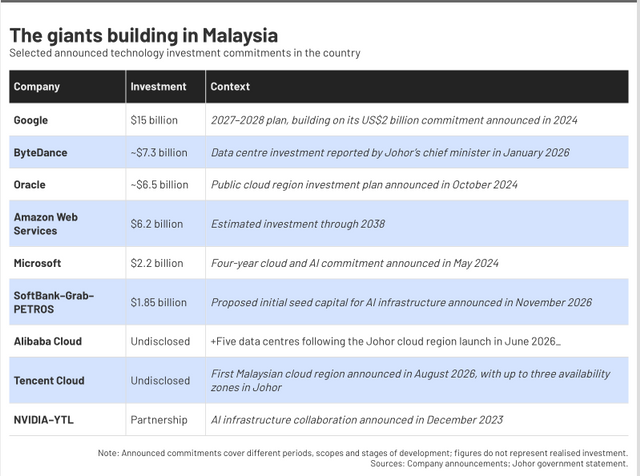
Just last week, Google arrived with a $15-billion investment plan, building on the $2-billion commitment it announced in 2024. It plans to deploy that sum over 2027–2028, expanding its digital infrastructure with new data centre campuses in Selangor and Negeri Sembilan, alongside initiatives in clean energy, water security and skills development.
A few days later, SoftBank and Grab stepped forward with their plans. Together with PETROS, they proposed $1.85 billion in initial seed capital under joint development agreements for AI infrastructure across Sarawak and Peninsular Malaysia.
The agreements put some scaffolding around an ambition Prime Minister Anwar Ibrahim outlined in October, when he said SoftBank founder Masayoshi Son had selected Malaysia for $50 billion in technology investments.
The playground already has some familiar occupants. Microsoft announced a $2.2-billion commitment over four years in 2024. Amazon Web Services plans an estimated $6.2-billion investment through 2038. Oracle has announced plans to invest more than $6.5 billion in a Malaysian public cloud region.
Including Google’s latest pledge and the SoftBank–Grab–PETROS proposal, those projected commitments alone exceed $31.75 billion, or roughly RM129 billion, nearly twice the net foreign direct investment Malaysia attracted across its entire economy in 2025. The commitments span several years, but their scale is striking for a country with a relatively modest home market.
What draws tech giants to Malaysia, and what opportunities could their capital unlock at home?
Malaysia’s appeal owes something to a neighbour running short of room.
When Singapore put new data centres on hold between 2019 and 2022, the demand for computing space did not politely wait. Some of it looked across the border.
Johor had room to build, lower land and construction costs, and proximity to Singapore’s established technology hub. Then the cloud and AI boom accelerated the race for computing capacity. Malaysia found itself holding something the giants increasingly needed: space to grow.
Malaysia had been dealt a good hand. It then made sure investors could play theirs by sweetening the deal.
Investment tax allowances offered relief on qualifying capital expenditure, while a Green Lane Pathway was designed to shorten electricity connection timelines from 36 to 48 months to 12 months, and industrial construction-permit and operating-licence processes were reported reduced from as long as three years to roughly 10 to 14 months. Malaysia has also kept its door open to competing technology powers, even as their rivalry grows.
For the giants committing capital, these advantages add up to a base from which to pursue ambitions well beyond Malaysia’s borders. Their public statements offer a glimpse of what they see:
“This investment aligns with Malaysia’s development priorities—providing the foundational computing capacity to deliver the upside of innovation across the country while adding local power and water resources as our operations scale,” Ruth Porat, Alphabet and Google President and Chief Investment Officer, as they announce their $15b Malaysia investment
“Sarawak’s focus on sustainable energy use and long-term vision make it a natural home for AI infrastructure that can serve all of Southeast Asia,” Anthony Tan, Grab co-founder, Chairman and CEO, following their recent billion-dollar investment with SoftBank
“A multi-region strategy can strengthen resilience, unlock capacity where and when it is needed, and create room to grow as Malaysia’s AI ambitions evolve. This is how we build Malaysia’s frontier future together,” Laurence Si, Microsoft Malaysia Managing Director, in a keynote address earlier this month
Malaysia is preparing the ground for more giants to come and play. A proposed Digital Infrastructure (Data Centre) Bill is intended for Cabinet consideration in 2027, while the Energy Commission is developing guidelines for self-generation and renewable energy use. Getting these rules right could give investors greater clarity on securing the power and water their plans require.
These mega investments will have a spillover effect on Malaysian businesses.
Google said it already works with more than 80 Malaysian entities across construction, engineering, network infrastructure, power and cooling components, and supporting services. Renewable energy developers need capital to build generation capacity; equipment makers and specialist contractors may need financing to expand and fulfil larger orders.
Google’s power purchase agreement with a consortium comprising Shizen Malaysia, Solarvest and HSS shows how computing demand can translate into business for adjacent industries.
The ripples are also showing up in valuations and earnings.
As of early November, shares in electrical engineering firm HE Group and engineering services provider Critical Holdings rose approximately 2.5 times their year-earlier level. Power infrastructure engineering firm Jati Tinggi’s latest quarterly net profit, meanwhile, more than doubled on the back of demand for power infrastructure and underground cable projects, particularly those linked to data centres.
Malaysia has persuaded the giants to build. The more valuable achievement would be to turn their spending into a springboard for domestic companies, giving suppliers the skills, scale and track record to win business elsewhere.
Market roundup
MISC-backed consortium bids for Yinson: A consortium backed by Yinson Holdings’ top shareholders and shipping major MISC proposed taking the energy infrastructure firm private at a valuation of RM7.31 billion ($1.8 billion).
IOI Properties launches $516m REIT IPO: IOI Properties Group launched a RM2.1-billion ($515.7 million) IPO for its property trust, which Maybank Investment Bank, a joint principal adviser, described as Malaysia’s largest-ever REIT IPO.
IFC weighs $90m Navis commitment: International Finance Corporation is considering investing up to $90 million alongside Malaysia-based Navis Capital Partners’ ninth buyout fund, which targets $1 billion.
Secai Marche expands regional cold chain: Japan-linked food distribution startup Secai Marche is expanding its Southeast Asian cold chain network, with about 70% of its product volume sourced from the region, particularly Malaysia.
Summit updates
The giants are bringing capital to Malaysia. How can local businesses and investors make the most of it? We’re taking that conversation to Kuala Lumpur in January 2027, bringing together investors, founders and industry leaders for DealStreetAsia’s Malaysia Capital and Growth Summit.
From data centres and semiconductors to homegrown businesses expanding abroad, we’ll explore where Malaysia’s investment momentum could create its next opportunities. There’s more to come as we build the agenda. More panel sessions, fireside chats, and keynotes will be added soon.