In this edition, we look at how Japanese institutional investors are setting a benchmark in navigating climate risks, and whether blended finance is truly achieving its objectives.
And can a $20-million cheque be enough to deal with the fallout from extreme weather events?
Scaling blended finance
Private capital mobilisation continued growing in 2025, with development finance institutions (DFIs) seemingly able to bring commercial investors into much-needed markets. Yet, driving private capital at scale to meet the trillions-of-dollar impact financing gaps needs examining.
Recent results from DFIs point to meaningful improvements, with several institutions generating at least $1 of private capital for every dollar of their own financing.
IFC, for example, reported a total commitment from its own account of nearly $28.3 billion, and $38.1 billion mobilisation from private investors last year.
Proparco also crossed an important threshold, exceeding its 1:1 private-capital mobilisation ratio for the first time by the year-end.
At ADB, its own financing for private investment increased 14% to $5.5 billion in 2025, while direct private capital mobilisation climbed 31% to $4.7 billion, from $3.6 billion a year earlier.
The increase was not simply a function of putting more public money to work. ADB said mobilisation was generated through a broader mix of instruments, including B loans, parallel loans, guarantees, equity, risk transfers and advisory support.
British International Investment (BII) offers another illustration. While it reported mobilising $1.7 billion from private investors, versus its commitment of 1.82 billion pounds ($2.4 billion) in 2025, a project-level example represents how DFIs bring commercial capital alongside their concessional capital.
BII anchored a $40 million first-loss tranche in Allianz Credit Emerging Markets – Allianz Global Investors’ private credit fund focused on emerging markets. At first close, the fund secured $690 million in commitments, including $540 million from commercial investors, with a target of eventually reaching $1 billion.
Other programmes, such as Norfund and the Green Climate Fund, recorded strong results of roughly 2x co-financing or private capital mobilisation.
However, mobilisation challenges have not been solved.
Australian Development Investments (ADI), for example, recorded zero additional private capital mobilisation in 2025, highlighting how difficult fundraising remains in emerging markets.
ADI expects sentiment to improve modestly in 2026, supported by patient, long-term capital, more innovative structures and more proactive fundraising. It still targets at least $3 of private capital mobilised for every dollar of Australian investment, and has to date attracted more than A$200 million ($142 million) private capital alongside its commitment.
The US International Development Finance Corporation offers another reminder that mobilisation does not move in a straight line. Its contracted investment volume fell sharply in FY2025, to $3.6 billion from $12.1 billion a year earlier. Yet the institution said it remained committed to maximising private capital mobilisation.
These may be isolated institutional snapshots rather than a comprehensive picture of 2025. The latest OECD report provides a broader context for the 2012-24 period, highlighting an upward trend of mobilisation, totalling more than $600 billion.
That progress was largely driven by isolated opportunities and remained much slower than expected, according to the OECD report. Capital through blended finance schemes was limited, constraining their ability to drive meaningful market transformation, it added.
The bigger question is, as the number of blended finance platforms grows, “how should they work together?” Munib Madni, CEO of Singapore’s blended finance FAST-P, wrote in a note.
It’s not about a lack of databases in the market, but rather collaboration among industry participants building understanding of everyone’s role in the larger ecosystem.
“Headline mobilisation ratios are useful, but they reveal only how much private capital was associated with catalytic support. They do not show whether that support changed investor behaviour, which barriers it addressed, or whether the resulting structure can eventually be replicated with less concessional capital,” Madni wrote.
That is arguably the more important metric for actual development.
How Japanese asset owners navigate climate risks and opportunities
A new report by the Asia Investor Group on Climate Change (AIGCC) examines how institutional investors in Japan navigate climate risks and opportunities that are increasingly material to financial returns.
In an analysis of 35 investors – comprising 22 asset owners and 13 asset managers with about 2.02 quadrillion yen ($12.4 trillion) in collective assets under management – AIGCC noted that Japan demonstrates one of the most mature climate investment markets in Asia.
More than half of the investors have committed to increasing investments in climate solutions or transition finance, suggesting that capital is increasingly being directed towards supporting the real-economy transition.
At the same time, more asset managers are disclosing physical climate risk and treating it as a mainstream investment consideration, the report noted. Investors are recognising that physical climate risk extends beyond transition risk to direct impact on assets, supply chains, and long-term portfolio returns both at home and abroad.
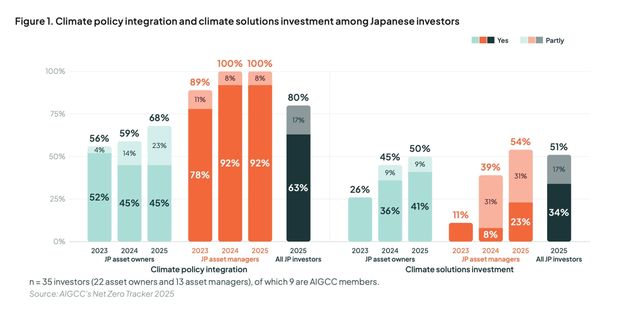 However, climate and just transition strategies for emerging markets and developing economies remain underdeveloped, AIGCC noted. Just 8% of the asset managers in the report have disclosed a climate strategy for the markets, while none of the asset owners did.
“This is an important gap for Japanese institutional investors to meet because they invest extensively across Asia, where transition pathways depend on energy access, infrastructure needs and industrial development,” AIGCC noted in its analysis.
“Asset owners can play a catalytic role through mandate design, blended finance participation and long-term allocations, while asset managers can integrate just transition considerations into due diligence, engagement, and capital allocation decisions.
“A stronger asset owner transition plan could explain how climate objectives affect strategic asset allocation, manager selection, portfolio targets, stewardship expectations, climate-solutions investment, and review processes.”
AIGCC recommends that asset owners disclose the policy issues that they prioritise, the governance applied to advocacy, and how external managers or industry organisations are monitored for alignment. “System-wide climate and market risks cannot be managed only through security selection,” the report noted. “Greater participation by asset owners would strengthen investor advocacy.”
Ultimately, to protect and grow returns, AIGCC noted, investors will need to accelerate the implementation of measures that strengthen portfolio resilience and capture the opportunities arising from the transition, and ensure they are prepared to keep pace with evolving regulatory requirements.
AIGCC is a network of more than 80 investors in Asia, with a combined AUM of $30 trillion.
“Humanity is on thin ice – and that ice is melting fast”
A fortnight on, more than 5,000 people are still missing after the devastating deluge of ice, rock and water inundated the valley along the Nepal-China border over a fortnight ago. At least 1,400 people have been killed.
The disaster was triggered by a glacial collapse high in the Himalayas, which encompass a region including India, Nepal, China, Tibet, Bhutan, and Pakistan. Warming has accelerated, and glaciers there are losing mass 65% faster than they were a decade ago, according to researchers.
Millions of lives and livelihoods are at risk. And scientists are cautioning that it is not the only place, nor the last, that is vulnerable to such catastrophic events. Similar regions include the Alps and the Andes.
The scale and implications of the most recent events are further thrown into relief amid reports that Nepal is seeking funds to cover some $4 billion to $7 billion in destruction, from the UN’s climate and loss and damage fund.
The Fund for Responding to Loss and Damage was established at COP28 in Dubai. In its latest report covering the period to 31 July 2026, the Fund noted it launched the call for funding requests at COP30.
It has since found 176, out of 198 funding requests it received, “compliant”. Those requests come from 119 countries in Africa, Asia Pacific, Latin America and the Caribbean, and Eastern Europe, and amount to $2.8 billion.
Meanwhile, total pledges to the Fund amounted to $822.71 million, of which $485.97 million was received. The Fund has yet to pay out anything.
Nepal has requested $20 million, the current ceiling for grants under the Fund’s initial phase, and will have to go through a multi-step process, including a vote taken by the Fund’s board, before any funds can be approved.
In its report, the Fund has also shown how a big part of funding requests concern damage and loss caused by extreme weather events. It remains unclear how the Fund, as it is set up now, is fit for purpose.
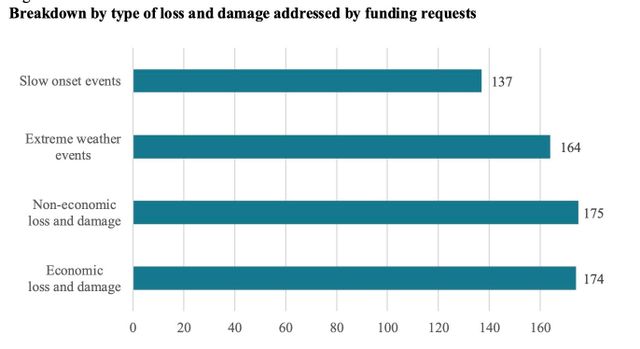
Source: UNFCCC – Third report of the Board of the Fund for responding to Loss and Damage (2026)
UN Secretary-General António Guterres made the statement on March 20, 2023, at the launch of the Intergovernmental Panel on Climate Change (IPCC) report.
Two years later, in 2025, noting record-breaking glacial ice loss, the UN inaugurated the World Day for Glaciers as well as the Decade of Action of Cryospheric Sciences, an initiative to drive urgent action to protect the Earth’s cryosphere – glaciers, ice caps, snow, and permafrost.
That could not come soon enough.
Climate deals in SE Asia
In August, Singapore-based mobility tech firm Strutt completed its pre-Series A+ round, bringing total funding in the business close to $100 million.
Meanwhile, Malaysian charging station startup Nichcom Go and Thai biotech company Living Roots raised undisclosed sums in their respective seed financing.