Fundraising for Southeast Asia-focused PE and VC funds remains constrained, while pan-Asian and global funds with minority allocations for the region continue to attract substantial commitments. The divergence suggests LPs still want Southeast Asian exposure, but favour cross-market managers over ring-fenced regional mandates.
DealStreetAsia DATA VANTAGE’s latest report, Southeast Asia Private Capital Funds: H1 2026 Review, finds that no dedicated regional PE fund reached a final close in H1 2026, while only one Southeast Asia-focused VC vehicle completed its raise. The weakness extended a retrenchment that has been unfolding since the fundraising peak of 2022.
Two dedicated PE final closes were subsequently announced in July, namely Analog Partners $150 million debut fund and ADM Capital’s $48 million climate fund. While their underlying closing dates may have fallen before the end of June, the apparent blank first-half performance should be treated cautiously.
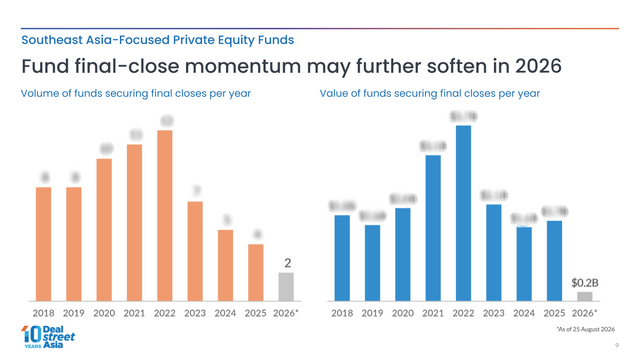
The weakness is more pronounced in VC. The sole H1 close was TheVentures’ $8 million vehicle, managed by a South Korean GP. No Southeast Asia-headquartered VC manager had reported a final close by August, underscoring the difficulty of converting LP interest into completed fundraises.
The announcements suggest that dedicated PE fundraising has been less uniformly weak, but headline proceeds increasingly depend on individual outliers. For instance, a single healthcare fund accounted for most of the capital raised in 2025, masking a much thinner market beneath the aggregate figure.
The Indonesian VC market faces an additional layer of scrutiny. Three of five VC funds that reached final closes in 2025 did not disclose values, implying they failed to meet targets or set unambitious goals; all three involved Indonesia-headquartered fund managers. This coincides with heightened investor concern over startup governance, policy predictability and exit visibility.
Capital shifts to scale
The picture changes markedly when the report’s analysis expands beyond dedicated regional vehicles. PE funds with minority allocations for Southeast Asia recorded their strongest semester by value in H1 2026 in terms of volume, led by large Asian and APAC vehicles managed by established global platforms.
BPEA Private Equity Fund IX, Blackstone Capital Partners Asia III and Bain Capital Asia Fund VI were among the largest closes. Their scale demonstrates that institutional capital remains available for Asia, but is increasingly concentrated among managers with established track records, broader geographical deployment flexibility and the capacity to absorb large LP tickets.
VC funds with minority regional allocations also performed better than dedicated Southeast Asian vehicles. Five reached close in H1, including funds managed by Peak XV Partners, Square Peg, Genesia Ventures and SCV. The improvement nevertheless represented a recovery from a weak base rather than a return to the stronger fundraising cycle of 2021 to 2023.
These vehicles matter because they provide another channel through which capital can reach Southeast Asian companies. Singapore also remains an important management hub for such strategies, particularly in VC, with regional managers accounting for a meaningful share of fund volume over the past five years.
As the entire dry powder is not ring-fenced for Southeast Asia, regional opportunities must compete with China, India, Japan, South Korea, Australia and other markets at the investment committee. Strong pan-Asian fundraising may consequently increase potential capital availability without translating proportionately into deployment across Southeast Asia, the report argues.
Specialisation gathers pace
The current pipeline suggests that funds are responding to tougher fundraising conditions through greater specialisation and more differentiated structures, the report finds. Broad mandates still dominate realised capital, particularly among large PE platforms, but sector expertise is becoming an increasingly important part of the fundraising proposition.
Funds are responding to tougher fundraising conditions through greater specialisation and more differentiated structures.
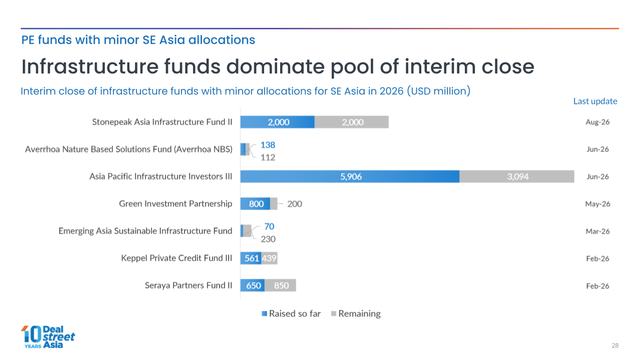
Infrastructure is one of the clearest themes. Funds targeting energy transition, power generation, connectivity and digital infrastructure have attracted substantial interim commitments. Demand for data centres, semiconductors and electricity generated by the AI buildout could reinforce this trend, although much of the resulting exposure may be classified under real assets such as infrastructure or real estate rather than technology.
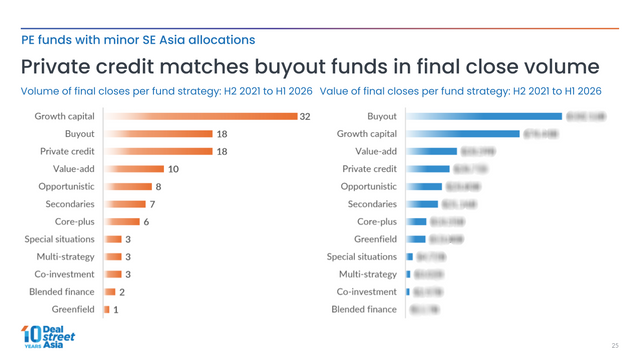
Private credit, secondaries, co-investment and continuation vehicles are also gaining relevance. These strategies can offer contractual income, liquidity or more targeted portfolio exposure when conventional equity exits remain difficult. For LPs, they provide greater control over duration, risk and deployment than a traditional blind-pool fund.
The report shows that VC managers are also sharpening their propositions. Motion Ventures Fund II targets maritime technology, Circulate Capital Asia II focuses on the circular economy, while B Capital is raising dedicated climate and healthcare vehicles. Onigiri Capital targets blockchain, and OCTAVE Capital’s Asia Ocean Fund is focused on the blue economy.
Specialisation alone, however, does not guarantee a successful raise. Debut managers and climate or impact funds have also struggled, while commitments have concentrated among successor vehicles and established platforms. The report argues that differentiation may attract LP interest, but conversion still depends on track record, DPI and realised returns.
A pipeline slow to convert
Interim-close data provide the clearest guide to future closing activity. The strongest pipeline lies among pan-Asian and global PE funds, where several large infrastructure, private-credit and buyout vehicles have secured substantial commitments and appear well positioned to reach final close.
Several Southeast Asia-focused PE funds have also passed the halfway point. These vehicles could support a recovery in fund volume, although their generally smaller targets mean they may have less influence on aggregate proceeds.
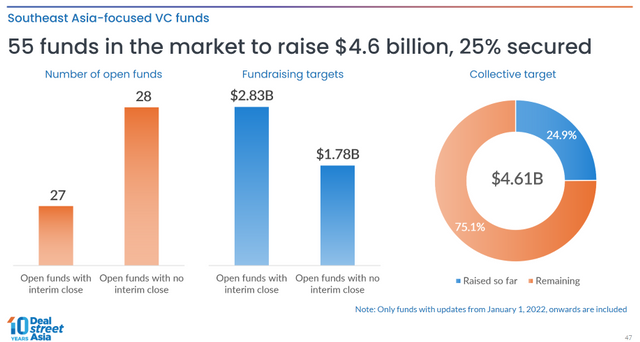
The VC pipeline is weaker, the report finds. Numerous vehicles have announced interim commitments, but many were last updated in 2022 or 2023 without subsequently reporting a final close. Some may still be raising or may not have disclosed further progress, while others may have fallen short of their targets.
Private credit specialist ADM Capital sees a disconnect between the asset class’s growing appeal and actual capital flows into regional Asia-Pacific funds. Lisa Genasci, ADM Capital’s managing director of sustainable finance, said in the report that LPs favour private credit for its income, shorter duration, downside protection and diversification, while Asia-Pacific offers attractive risk-adjusted returns backed by senior security and private equity-like governance rights.
“Amid a complex geopolitical backdrop and an elevated interest rate environment, increased interest in private credit has not yet translated into capital flows into regional Asia Pacific funds,” Genasci said.
Genasci said climate-focused private credit can attract greater interest than conventional Asia credit funds among DFIs, development banks, European institutions and impact-oriented family offices, given recognised financing needs in energy transition, food systems, sustainable land use and climate resilience. However, she noted that the potential LP pool is narrower and fundraising timelines are often longer.
While recognising that investors are reassessing geopolitical, policy and macroeconomic risks across emerging markets, Matt Leggett, co-founder and CEO of Terratai, an Indonesia-based venture builder focused on climate and biodiversity, said his conviction was grounded in a longer-term structural opportunity and imperative.
“If we care about impact, we simply can’t ignore Southeast Asia,” Leggett said in an interview for the report.
The region, he said, is home to globally significant forests, peatlands, mangroves, coral reefs and biodiversity, which sustain hundreds of millions of people and underpin major economies. Despite its challenges, Leggett believes Indonesia offers a strong base of entrepreneurs in regenerative agriculture, sustainable forestry, marine systems and the circular bioeconomy, with models that could support the wider green transition across the region.
The next cycle takes shape
The direction of global capital will remain decisive. The report argues that elevated interest rates, volatile bond markets and geopolitical fragmentation are raising return hurdles and reinforcing LP concentration around managers with scale, track record and demonstrable distributions.
The report’s PE findings suggest that much of the available capital will sit within pan-Asian and global vehicles. Southeast Asia must compete with China, India, Japan, South Korea and Australia for deployment, favouring larger buyouts, private credit, infrastructure and data-centre platforms over country-specific and lower-middle-market opportunities.
Separately, the VC analysis points to growing concentration around AI, semiconductors, compute infrastructure, enterprise software and globally scalable businesses. US-China technology restrictions could redirect some supply-chain and digital-infrastructure investment towards Southeast Asia, but weak IPO and M&A markets will continue to constrain fundraising.
Across both asset classes, sovereign and strategic capital may place a floor under selected segments. Singapore is expanding state-supported investment programmes, Malaysia’s Khazanah is anchoring selected managers, and Indonesia’s Danantara has signalled interest in AI-focused funds. Such support is likely to remain concentrated in national priorities.
The report therefore expects the next cycle to become more thematic, structured and sovereign-influenced, but not necessarily broader. Specialist positioning may open doors, yet DPI, governance and credible exits will determine which managers convert interest into final closes.
The full report, which is available to all DATA VANTAGE subscribers, examines closed-ended PE and VC funds with dedicated and minority Southeast Asian allocations, covering historical final-close performance, interim commitments and the wider pipeline. Fund-of-funds vehicles are excluded to avoid double-counting capital available for direct investment.
Download the Southeast Asia Private Capital Funds: H1 2026 Review for insights into:
- Half-yearly and annual PE and VC fundraising trends
- Fundraising by strategy and sector, including climate and impact funds
- Which funds have announced interim closes
- Which are the newly launched funds in the market
- Fundraising trends by Global PEs with SE Asia allocations
- Insights from fund managers
The report is available exclusively to DealStreetAsia–DATA VANTAGE subscribers. Subscribe/upgrade your subscription now to access our entire set of reports. Still not sure? Opt for a one-month trial for only $249 or reach out to subs@dealstreetasia.com for a demo.