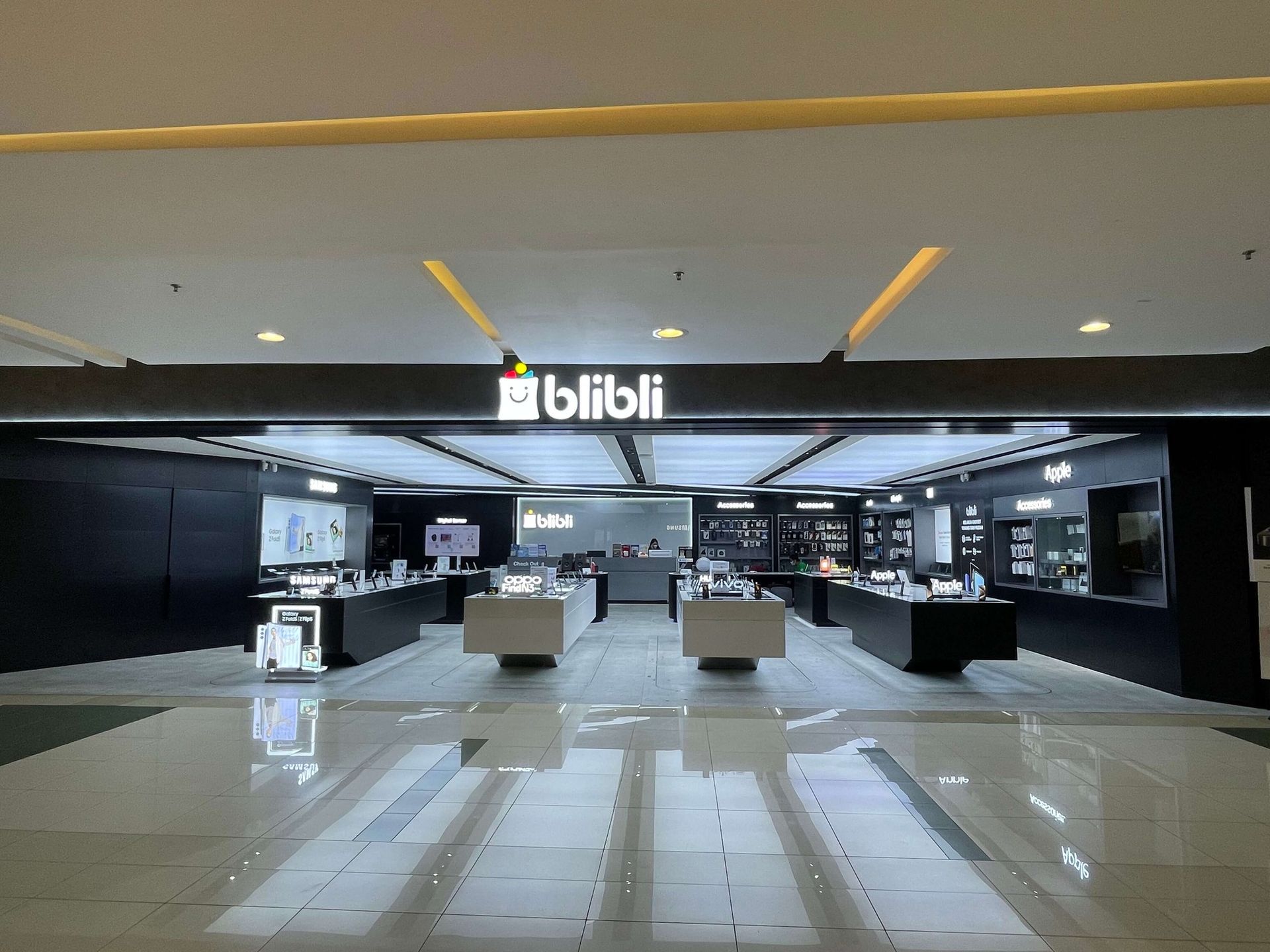
PT Global Digital Niaga Tbk, the Indonesia-listed retail and e-commerce group that owns Blibli, Tiket.com, Ranch Market, and Dekoruma, reported stronger second-quarter revenue and sharply narrowed its first-half losses as growth in its institutional business and tighter cost controls improved profitability despite continued investments in expanding its offline retail network.
The company’s net revenue rose 43% year on year to 6.99 trillion rupiah ($387 million) in the April-June quarter, driven by a 67% jump in institutional sales and a 25% increase in revenue from physical stores. Total processing value (TPV) increased 15% to 23.21 trillion rupiah ($1.3 billion), while gross profit before discount (GPBD) grew 12% to 1.89 trillion rupiah ($104.6 million).
The stronger second-quarter performance extended into the first half of the year, with the company reporting a marked improvement in profitability as operating expenses grew at a much slower pace than revenue. General and administrative expenses fell 7% year on year even as revenue expanded 55%, allowing operating loss to narrow by more than half.
For the six months ended June, Blibli posted net revenue of 14.83 trillion rupiah ($820.5 million), up 55% from a year earlier, while gross profit increased by 31% to 2.32 trillion rupiah. Operating loss narrowed 57% to 493 billion rupiah, while loss before income tax improved 46% to 651 billion rupiah. Net loss also narrowed 43% to 719 billion rupiah.
“The first half of 2026 further demonstrated the resilience of our integrated omnichannel ecosystem and the consistency of our long-term strategy. Amid increasingly selective consumer spending and intense market competition, we delivered healthy revenue growth while continuing to improve profitability,” chief executive officer and co-founder Kusumo Martanto said in a statement.
“The progress reflects our focus on quality growth, disciplined investments, and operational excellence, rather than pursuing growth at all costs,” he added.
The institutional business remained the group’s fastest-growing segment during the first half, with revenue almost doubling to 6.71 trillion rupiah. Revenue from physical stores rose 41% to 4.45 trillion rupiah, while first-party retail revenue, which includes e-commerce Blibli and Dekoruma, increased 23% to 2.87 trillion rupiah.
Third-party retail revenue, which includes its OTA Tiket.com, grew a more modest 11% to 806 billion rupiah. Overall TPV climbed 12% to 45.19 trillion rupiah, supported by double-digit growth in the institutional and physical store businesses.
Chief financial officer Ronald Winardi said the company’s performance reflected healthy growth across all business segments alongside a continued focus on higher-margin products and operational efficiency.
“Our first-half results demonstrate the continued strength of our execution, with net revenue increasing 55% year on year, supported by healthy growth across all business segments and a focus on higher-margin product categories. At the same time, our continued emphasis on cost discipline and operational efficiency has enabled us to further strengthen profitability while supporting sustainable growth,” he said.
The company also reaffirmed its 2026 guidance, expecting consolidated net revenue to grow 15-20% this year. The management said it would continue prioritising margin improvement and a more efficient cost structure in the second half as it seeks to sustain its progress towards profitability.
Blibli’s Q2 2026 financial performance
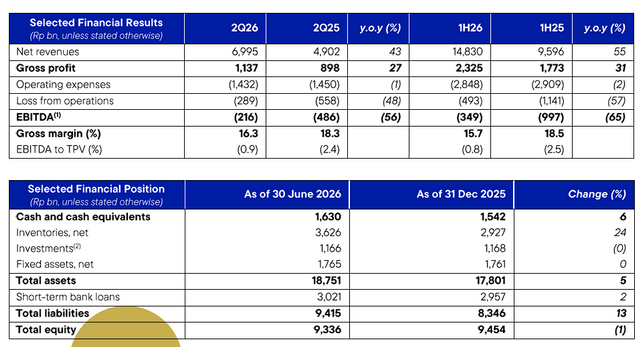
The balance sheet also reflected the company’s ongoing expansion. Inventory rose to 3.63 trillion rupiah at the end of June from 2.93 trillion rupiah at the end of 2025, while third-party trade payables increased 56% to 3.01 trillion rupiah over the same period, in line with higher sales volume. Cash and cash equivalents stood at 1.63 trillion rupiah, slightly higher than the 1.54 trillion rupiah six months earlier.
Finance costs climbed to 182 billion rupiah in the first half from 118 billion rupiah a year earlier, reflecting higher borrowing and financing expenses as the company continued to invest in its operations. Total short-term bank loans edged up to 3.02 trillion rupiah from 2.96 trillion rupiah at the end of last year, while the company also drew 30 billion rupiah in new long-term bank loans.
Blibli’s cash generation also improved during the period. Net cash used in operating activities narrowed sharply to 180 billion rupiah from 2.56 trillion rupiah in the corresponding period last year, suggesting a significant improvement in operating cash generation, although the company remained cash flow negative.
Operationally, the company continued to strengthen its omnichannel network by launching its “Prioritas”, a priority delivery service, which promises deliveries starting from 30 minutes after payment; and adding 36 stores during the second quarter.
As of the end of June, Blibli operated 326 consumer electronics stores, which consisted of 159 monobrand stores and 167 multibrand stores, 14 home appliance stores, one fashion and sports store, 60 premium supermarkets, and 38 home and living experience centres.