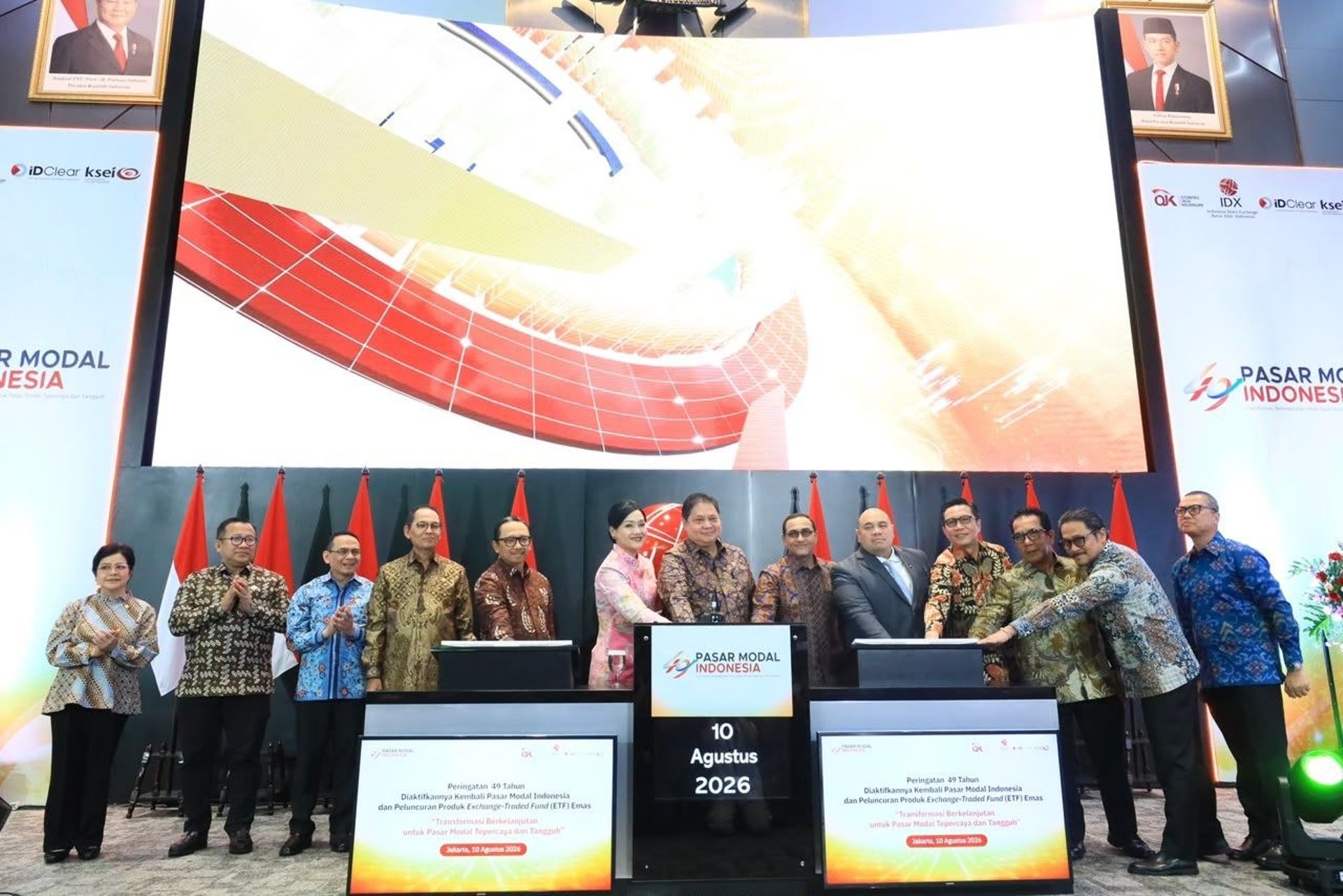
Indonesia has launched five gold exchange-traded funds (ETFs) on the Indonesia Stock Exchange, giving investors a new way to gain exposure to gold through the capital market as the government develops the country’s bullion ecosystem.
The launch comes as the Financial Services Authority (OJK) positions gold ETFs as one of eight “quick wins” under its action plan to deepen the capital market in an integrated manner.
“Gold ETFs offer a practical and liquid investment, comply with sharia principles, serve as a haven, and at the same time expand the bullion market through collaboration among institutions and industry players,” OJK Chairwoman Friderica Widyasari Dewi said at the launch in Jakarta on Monday.
The five ETFs, which started trading on Monday, are Trimegah Syariah ETF Emas (XTRA) at 248 rupiah per unit, Mandiri ETF Emas (XMES) at 757 rupiah, BRI MI Gold ETF Syariah (XDES) and Syailendra ETF Sharia Gold (XSGO) at 1,000 rupiah each, and Premier ETF Gold Sharia Indonesia (XGLD) at 256 rupiah. The funds are managed by Trimegah Asset Management, Mandiri Manajemen Investasi, BRI Manajemen Investasi, Syailendra Capital and Indo Premier Investment Management, respectively.
The ETFs are part of an effort to link Indonesia’s bullion industry with the capital market. Indonesia Central Securities Depository (KSEI) President Director Samsul Hidayat said the structure connects physical gold used as the underlying asset with electronic gold receipts (EGRs) recorded at KSEI before the ETF units are traded on the IDX.
Deputy Finance Minister Juda Agung said the launch should be viewed as more than the addition of a new investment product. Global gold ETFs had $559 billion in AUM and held around 4,025 tonne gold in 2025, he said.
“This reflects the growing importance of this instrument in the global investment ecosystem. So, what we are doing today is not simply adding one product,” Agung said.
He said the products could broaden investment options and deepen Indonesia’s financial market, helping it become more competitive with regional and global markets.
The government began developing Indonesia’s bullion business in 2023. Agung said gold should not only function as an asset held by investors but also be connected to broader financial instruments and markets.
Fund managers target AUM
Syailendra Capital is targeting AUM of 100 billion rupiah to 200 billion rupiah for its Syailendra ETF Sharia Gold, or XSGO, by year-end, President Director Fajar R Hidayat said after the launch ceremony.
Hidayat said institutional demand for gold ETFs could be significant, although the product would require more education among retail investors, particularly on how ETFs are bought and traded through the stock market.
“For institutional investors, I think gold ETFs are already very safe. I think many institutions will be interested in this product,” he said.
Trimegah Asset Management is also targeting several hundred billion rupiah in AUM for its Trimegah Syariah ETF Emas, or XTRA, by the end of the year, although President Director Antony Dirga did not give a specific figure.
“Hopefully, by the end of the year it can reach several hundred billion rupiah. I think we have the same spirit — the five of us are together in showcasing gold ETFs,” Dirga said.
He said the ETFs would give investors another way to gain exposure to gold through the capital market. Unlike physical gold, ETF units can be traded on the secondary market on the IDX in the same way as listed securities.
For OJK, the ETF launch is part of a wider push to deepen the capital market. As of Aug. 7, Indonesia had 30.27 million single investor identifications (SIDs), up 48.67% year-on-year, while the market had raised 123.21 trillion rupiah through 135 corporate actions. The number of listed issuers had surpassed 962, according to the regulator. The Jakarta Composite Index, however, was down 25.87% year-to-date as of Aug. 7, amid broader market pressures and uncertainty surrounding Indonesia’s equity market.
OJK is also working on several structural reforms, including a framework for exchange demutualisation, as part of the final phase of its 2022-2027 capital-market roadmap. Other priorities include market deepening, stronger enforcement and issuer quality, cybersecurity and sustainable finance.
Separately, the IDX plans to add an affiliation-status column to its disclosure of shareholders holding more than 1%, according to IDX President Director Jeffrey Hendrik. The move will show whether shareholders are affiliated or unaffiliated and is aimed at making ownership data easier for investors to assess.