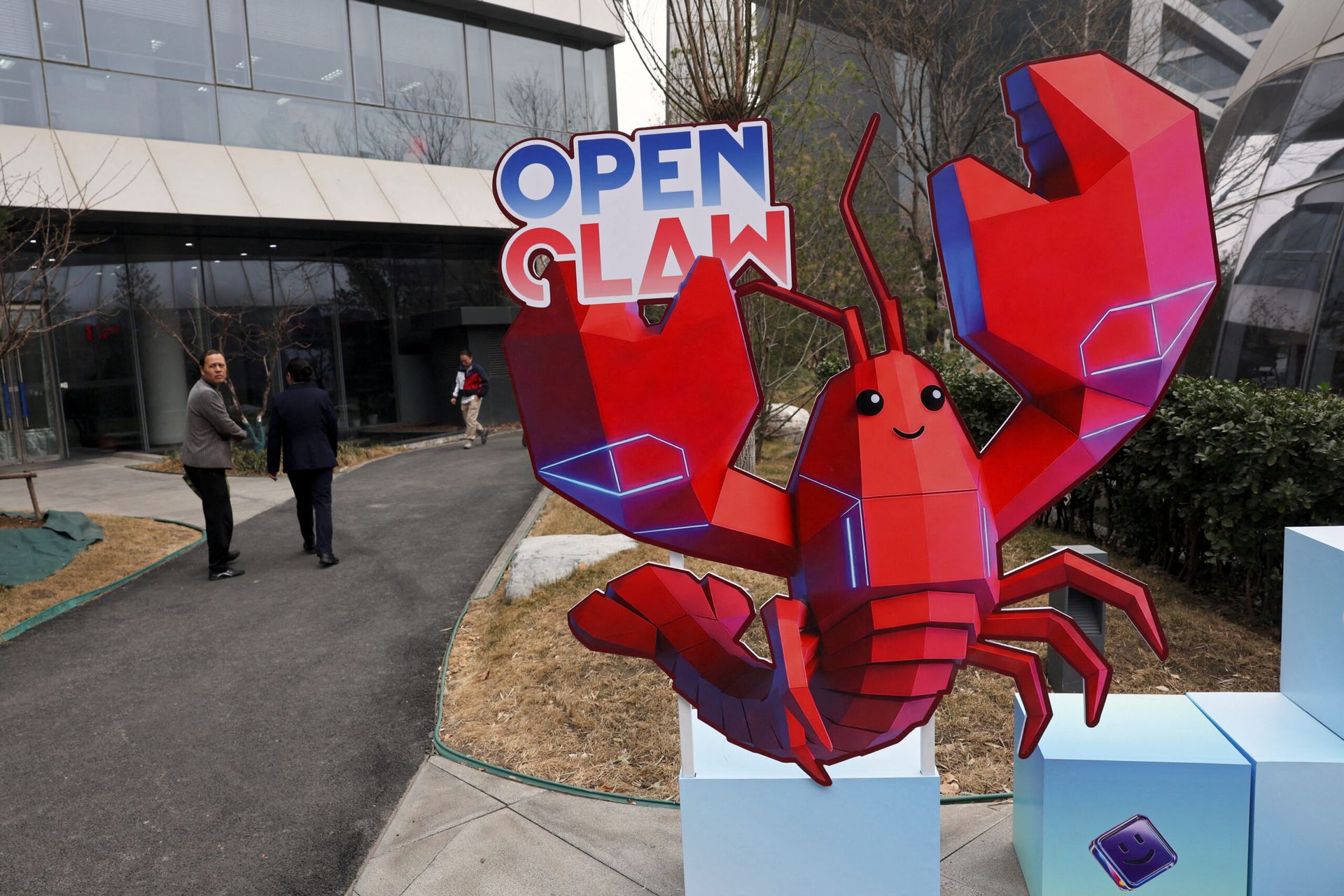
Liu, a Hangzhou-based contractor at a large Chinese internet firm, says her employer began quietly firing contractors in March after it ordered staff to use AI tools including AI agent OpenClaw, which saw lightning-fast adoption in China this year.
While she does not know the full scope of the layoffs, her employer has also started reducing graduate hiring as Chinese companies race to implement AI systems.
“The tasks most people do can be completely replaced by OpenClaw. After a person writes all their workflows (into OpenClaw)… they can basically be fired,” said the 26-year-old, who asked not to use her full name or her company due to the sensitivity of the subject.
While companies around the world are grappling with AI adoption, Chinese firms face a unique challenge: Beijing wants companies to adopt AI fast enough to transform productivity, but not so fast or visibly that workers are pushed out in numbers that threaten social stability.
Liu’s company is among a number of Chinese enterprises quietly implementing small-scale layoffs as they seek AI-linked productivity gains without attracting government scrutiny, nine workers from industries spanning tech, entertainment and advertising told Reuters.
Their strategy contrasts with massive AI-linked job cuts announced by major global companies including Meta, which have triggered a wave of anti-AI populism in the West.
China’s State Council and human resources ministry did not immediately respond to faxed requests for comment.
COMPANIES SEEKING TO AVOID MASS LAYOFFS
Under Chinese labour laws, companies must seek government approval for job cuts exceeding 10% of their workforce, and Chinese courts have in at least three cases ruled against companies that dismissed workers to replace them with AI.
“Private companies will need to make room for some level of inefficiency in order to avoid mass layoffs that would prompt ‘social instability’ and could have political ramifications,” a senior manager at a big Chinese fintech company told Reuters.
The person said restructuring is already happening at every big tech firm in China, with marketing and front-end jobs largely replaced by AI.
An engineer at Alibaba’s cloud division also said AI-driven headcount reductions have begun in parts of the company and are likely to unfold through gradual cuts and attrition rather than a single mass round of lay-offs.
Alibaba did not respond to a Reuters request for comment.
He Shujing, a senior analyst at consultancy Plenum, said big Chinese tech firms remain in an “all-in phase” on AI.
“The productivity gains from AI will likely reduce hiring needs, but large companies are expected to be cautious about making direct workforce cuts.”
AI PERFORMANCE TARGET
Some firms are not only using AI to replace tasks and roles but also measuring whether workers are adopting it fast enough. Employee use of tokens, a unit of AI compute consumption, is being measured in some workplaces to estimate efficiency – although that doesn’t translate to direct productivity gains or indicate the quality of work produced using AI.
A big data engineer at a Chinese tech giant said his manager began ranking employees by token usage in March, adding that the metric will be linked to their performance reviews and promotion prospects.
“It is relatively forced. One should not use AI for the sake of it,” he told Reuters on condition of anonymity. “I still can’t shake the feeling that I’m getting closer to being replaced.”
Entertainment is among the industries most heavily disrupted, as low-budget micro drama studios shift to AI-generated actors and sets.
“We had 30-40 people in our production department. After the transition (to AI), each group was cut down to about 10 people, with only two remaining for live-action filming,” said Ayase, a 22-year-old micro drama producer who was fired in February.
“With live-action, a single actor costs thousands of yuan per day, even for a minor role with just a few lines,” said the recent graduate.
AI BOOM, JOBS SQUEEZE
Beijing’s “AI Plus” initiative targets 70% AI adoption across key sectors by 2027 and 90% by 2030, and analysts warn there will be a difficult transition period.
They say the speed of AI-driven job creation lags behind the speed of job displacement, while China is already wrestling with a high youth jobless rate, with early-career workers disproportionately exposed to AI automation.
While AI-related job postings surged 74% in 2025, this boom belies a struggling wider market where a record 12.7 million university graduates face declining entry-level pay and fewer jobs.
Citibank estimated in a recent report that 9.6% of all Chinese jobs – roughly 70 million – are at high risk of AI-driven displacement. That risk rises to 13.6% for workers in their 20s.
“AI sits at the centre of China’s (economic) transition in a particular way: it is simultaneously a driver of the disruption and the proposed solution to it,” said Selena Guo, social policy analyst at advisory firm China Policy.
“Wide-scale AI adoption is needed to achieve industrial efficiency (and) accelerate innovation… The hope is a positive snowball effect on productivity and growth.”
Chinese state media articles have attempted to reassure workers that AI is not “stealing people’s rice bowls”. Officials are currently studying the impact of AI on employment and reskilling plans, but they have yet to issue a detailed policy response.
The hashtag “AI anxiety” gained over 7.8 million views on Chinese social media app RedNote, where users debate whether AI will make them obsolete like the 19th-century European weavers who lost their jobs to power looms.
Some AI agent tools are already explicitly marketed to replace entire departments: Wukong, Alibaba’s multi-agent AI enterprise platform, for example, features pre-set “one-person company” skills designed to automate jobs including e-commerce sales, livestreaming and software development.
“Those who don’t use AI will be eliminated,” said Liu, who works in content operations.
“AI penetrating every aspect of life is only a matter of time… I want to go back to farming, or become an artisan.”
Reuters