New energy businesses in Asia are facing limited equity financing as large infrastructure funds favour bigger, established companies.
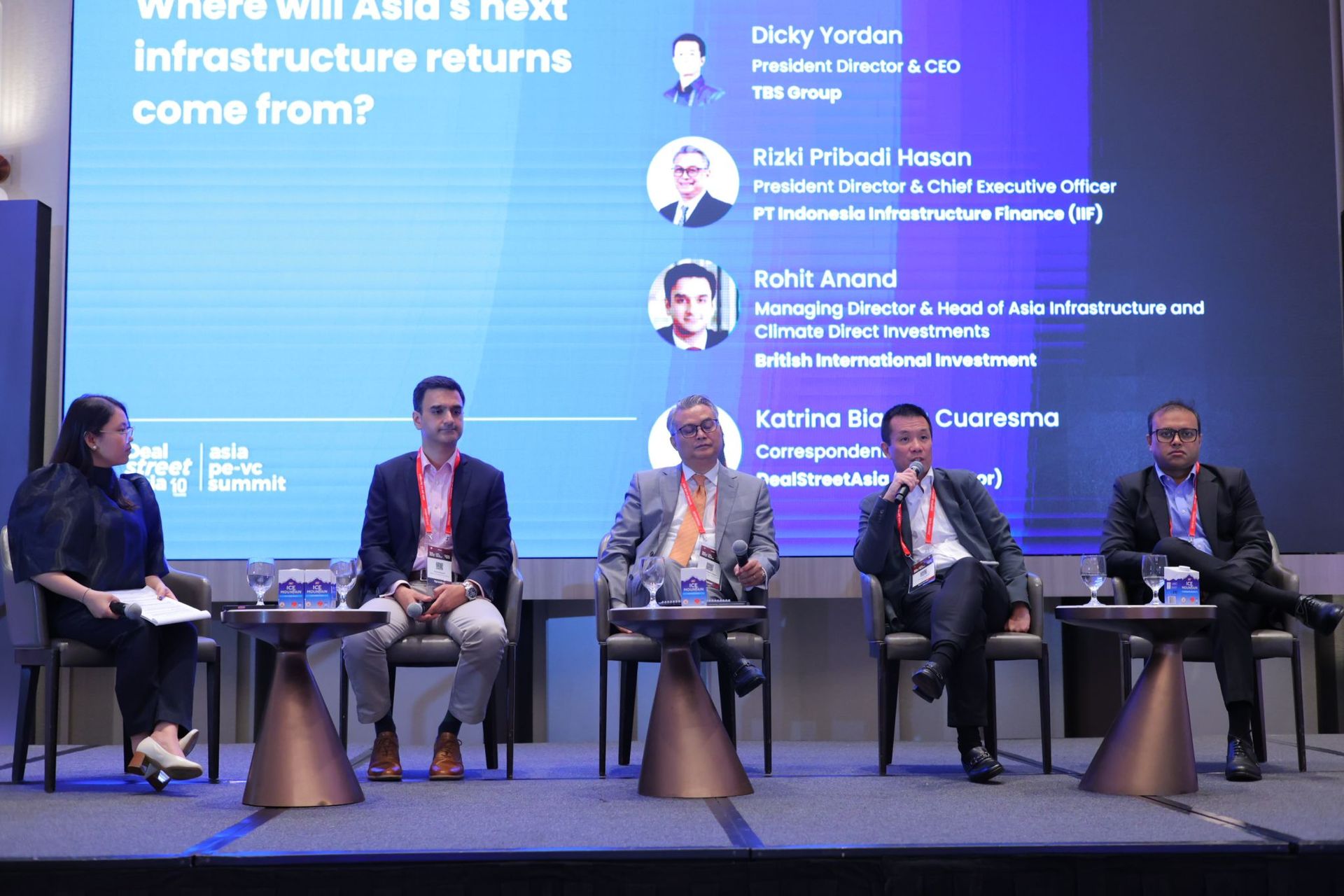
The funding gap offers opportunities for investors willing to develop renewable energy projects and build businesses that can later attract larger funds, according to panellists at DealStreetAsia’s Asia PE-VC Summit 2026 in Singapore last month.
Rohit Anand, managing director and head of Asia infrastructure and climate direct investments at British International Investment, said equity remains scarce for building new projects and companies.
“I don’t think the equity market is oversupplied. I think the equity market, when it comes to building new projects and building new companies, is actually quite undersupplied.”
“So if you talk to an entrepreneur who’s trying to start an energy company, it’s a very very difficult thing to do… There’s a shortage of capital given the need,” Anand added.
The executive said the infrastructure market had consolidated towards large fund managers that often have minimum deal sizes of $300-500 million. Relatively fewer investors are involved in building companies from scratch, while most prefer to enter once management teams and the initial building blocks of a business are established.
He identified buy-and-build transactions in energy and structured credit as areas where BII sees opportunities.
The financing challenge comes as Southeast Asia’s energy needs expand. The International Energy Agency’s Southeast Asia Energy Outlook 2026 has projected that the region will account for nearly 20% of global energy-demand growth by 2035 under prevailing policy settings. Energy investment exceeded $100 billion in 2025, representing around 3% of global energy investment.
Rahul Agrawal, managing director for energy infrastructure at Actis, pointed to opportunities in developing renewable energy businesses across India and Southeast Asia before they reach the scale sought by larger investors.
The opportunity involves building businesses capable of navigating the risks of developing power projects, rather than simply acquiring assets and waiting for returns, he said.
“And what I mean by that is not just building a project; it’s executing the whole business plan: from regulatory risk, commercial risk, team identification, partner selection,” Agrawal said.
“You can’t just buy and sit there for returns to come. In our markets, there are not many things to buy also because the infrastructure is generally still getting built out. These are still growth markets and developing countries.”
Power demand beyond AI
Actis has been buying and building renewable energy platforms across India and Southeast Asia, Agrawal said. Underlying electricity needs and energy security support the investment opportunity beyond demand from artificial intelligence.
“I think the deep structural need for new power, energy security is there,” he said.
According to the IEA’s 2025 Energy and AI report, Southeast Asia’s electricity demand from data centres will more than double by 2030, partly reflecting the regional hub in Singapore and southern Malaysia.
Dicky Yordan, president director and CEO of TBS Group, meanwhile, said renewables are one of the company’s three business pillars, alongside waste management and electric mobility. Data centre development is helping shape its power investments.
“As we all know, AI has been one of the largest infrastructure build-outs the digital economy has seen, with data centre at its core.”
“In Southeast Asia, it’s yet to be seen whether all of that power can be supplied by renewables or not. However, we are putting our effort there on top of the hydro project that’s already up and running. We are currently building a 46 megawatt peak floating solar panel in Batam,” Yordan added.
Rizki Pribadi Hasan, president director and CEO of Indonesia Infrastructure Finance, similarly highlighted the relationship between demand for renewable energy and telecommunications infrastructure.
Renewable energy and telecommunications are among the sectors Indonesia Infrastructure Finance sees as most attractive, he said. “There is a growing demand in renewable energy and also under telecommunication, and these two kind of link to each other.”
Hasan also identified water and waste as opportunities for investors prepared to take different risks, with regulation and supporting infrastructure still developing.
Turning demand into investible businesses
Financing opportunities also extend beyond equity. Anand highlighted mezzanine financing, citing fewer providers and transactions that can deliver returns comparable to equity.
He said higher returns available in Western markets had reduced the incentive to invest in Asia, affecting capital availability across financing structures.
For investors developing businesses, Agrawal said building a platform involves assembling management teams, making smaller acquisitions, developing projects, bidding for power purchase agreements and taking construction risk. Operational improvements, refinancing and stronger governance can subsequently make the business suitable for a larger investor.
Predictable cash flows remain fundamental to that approach.
Yordan identified execution and capital structure as the two most important factors from an operator’s perspective. He pointed to TBS’s experience completing two power plants in Indonesia during the pandemic.
“The strongest return is not in any single sector. It can come from being where structural demand meets contracted and essential infrastructure. Essentially, where a real problem meets paying customers,” he said.
Hasan said investors need to undertake detailed studies or find partners able to help navigate the challenges of individual infrastructure sectors.
“Or you can find an easier way, which is to partner with someone that can navigate you with all the challenges that it is facing in every sector of the infrastructure, and bear in mind that each infrastructure sector has its own challenges.”
For Actis, local experience includes understanding partners, land issues, grid connections and community interests. Agrawal said that knowledge takes time to develop.
“It’s not about presence; it’s about depth. You can’t just have an office. You need to have people who have been doing that stuff for several years, and it takes time to develop that.”