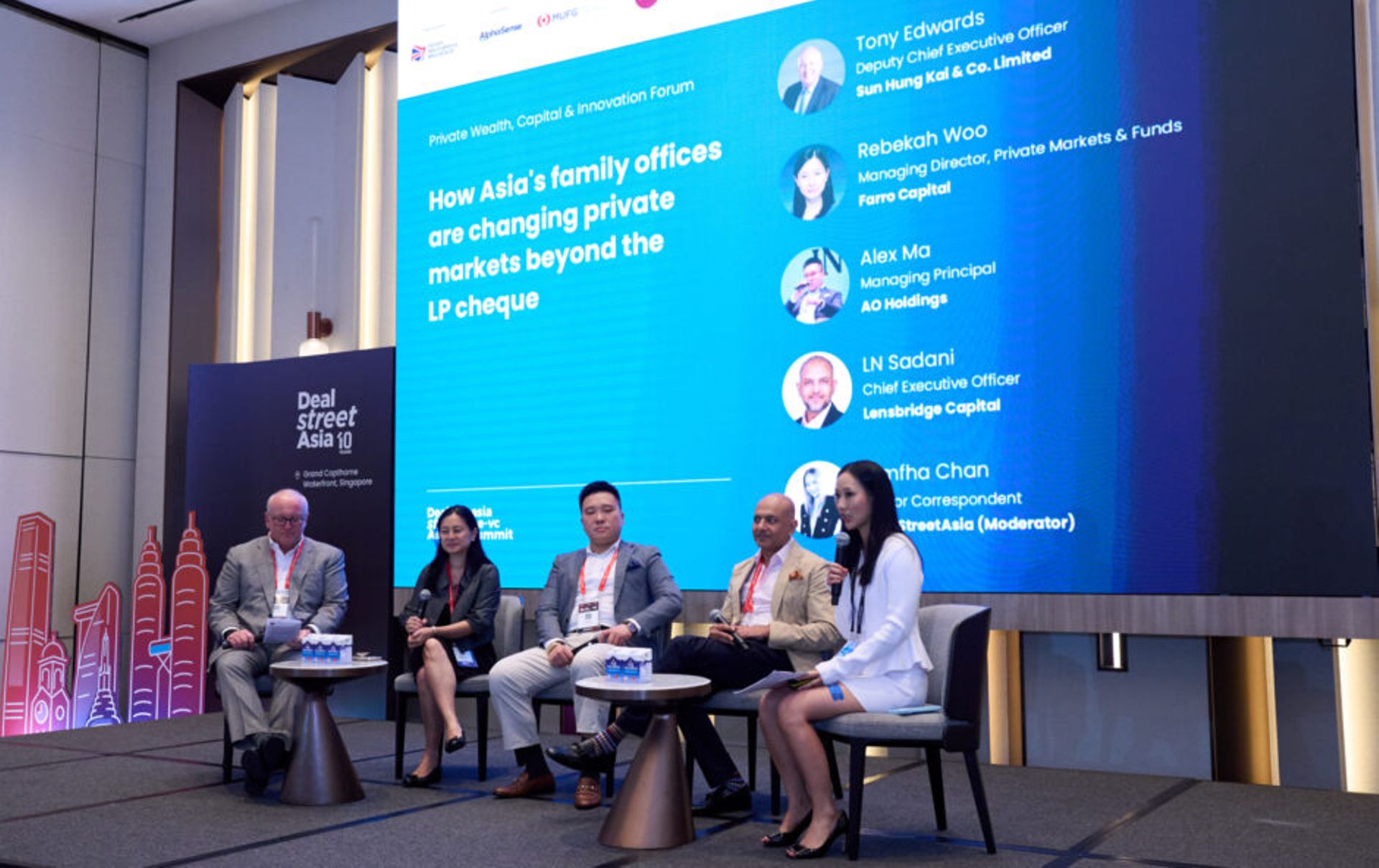
Asian family offices are increasing their exposure to private markets but becoming more selective about where and how they deploy capital, with private credit and secondaries emerging as preferred strategies for investors seeking downside protection and greater flexibility.
Tony Edwards, deputy CEO of Hong Kong-listed family office and alternatives platform Sun Hung Kai & Co., said his firm is moving more capital from private equity into credit opportunities as it seeks greater stability.
“We’re now moving more out of private equity into more credit opportunities,” Edwards said during a panel discussion on September 24 at the Asia PE-VC Summit 2026. “We’re seeking more stability and downside protection from that.”
SHK Capital Partners, which manages HK$29 million ($3.7 billion) in alternatives assets, has partnered with secondaries funds such as Clipway, Singapore’s Aquilius, Hunter Point Capital as well as asset managers such as Mubadala Capital and Janus Henderson.
Rebeckah Woo, who heads private markets and funds at Singapore-headquartered multi-family office Farro Capital, said many of the families she works with are prioritising capital preservation.
“Many of our families that make a lot of returns already in their core business do not feel like they need to take a lot more risk in their family office portfolio.”
Private credit has, therefore, become a higher priority because of its income generation, low loss rates and potential for additional upside, she said.
The shift is also reflected in regional allocation data. Southeast Asian family offices allocated 4% of their portfolios to private debt in 2025, alongside 14% to direct private equity and 6% to private equity funds, according to UBS’s 2026 Global Family Office Report. Overall, 81% of family offices in the region said they planned to make changes to their strategic asset allocation in 2026.
AI infrastructure is another area attracting family-office capital, particularly through credit funds lending to data centres, cloud companies and other parts of the AI infrastructure ecosystem.
“We have slightly tuned our portfolio towards AI infrastructure. We’re first deploying into private credit funds that lend into AI, AIDC, new cloud and things around AI infra,” said Alex Ma, who runs Singapore-based single-family office AO Holdings.
“I don’t believe anybody can predict AI, whether it’s a bubble or when the bubble is going to burst; but with ‘picks and shovels’, we are more focusing on capital preservation.”
Ma said his firm has also participated in venture transactions where managers need additional capital late in a fund’s life to maintain stakes in portfolio companies. In other cases, it has provided capital to help managers generate distributions by offloading portfolio holdings.
Secondaries have likewise become a growing part of family offices’ investment toolkit, particularly as investors seek greater control over liquidity and the assets they are buying.
Farro, which has over $3.5 billion in assets under management, is also seeing growing interest in venture-capital secondaries, particularly single-asset special purpose vehicles, although Woo acknowledged the strategy carries significantly more risk.
LN Sadani, founder of Singapore-based Lensbridge Capital, said his firm focuses largely on GP-led secondaries and prefers single-asset continuation vehicles because they allow investors to underwrite individual companies more closely.
Sadani, a founding member of Ardian’s Asia office, has nearly three decades of private-capital experience and has deployed and advised on more than $5 billion of transactions across Asia and globally.
“We like single-asset GP-led secondary transactions rather than a portfolio of assets in there because we can then evaluate those assets a lot better,” Sadani said. His firm is also willing to look at tail-end fund portfolios when it can identify “trophy assets” that could be transferred into continuation vehicles.
Family offices are also seeking more flexible ways to access private assets as they become increasingly reluctant to commit capital to very long-dated funds.
“The movement towards the so-called evergreen and open-ended private markets opportunities is a very interesting one that we’re watching very closely,” Woo said.
The shift towards flexible structures comes as private markets become a larger but more complex part of family-office portfolios. UBS found that 60% of family offices globally planned to change their strategic asset allocation over the next 12 months, with 65% already invested in artificial intelligence across areas including data-centre infrastructure, software and semiconductors. Southeast Asian family offices were even more active, with 81% planning allocation changes and 88% already invested in AI.