Sovereign investors in the Gulf Cooperation Council (GCC) region have evolved from being mere capital providers to looking at strategic cross-border investment mandates and expanding trade corridors with Asia.
In this, they are partnering with other state investors and favouring managers who are aligned with the region’s long-term interests across key sectors including fintech, digital infrastructure, logistics, and health and life sciences.
This has become a key factor at a time when the region is mired in a protracted conflict that has exacerbated market volatility and an already-challenging operating environment.
“There’s this widening gap between allocators and investors that are actually present in the region, and the ones that have been more tourists in the region,” said Nader Albastaki, Managing Director, Dubai Future District Fund, a venture capital fund-of-funds.
“The number one thing that we’re looking at is: Is there an engagement model that’s present that’s strategically aligned between ourselves and the managers that are coming into the region? We’re seeing a lot more continued investment and conviction from the ones with a presence that understand the situation and the fundamental medium-term, long-term growth story of the region.”
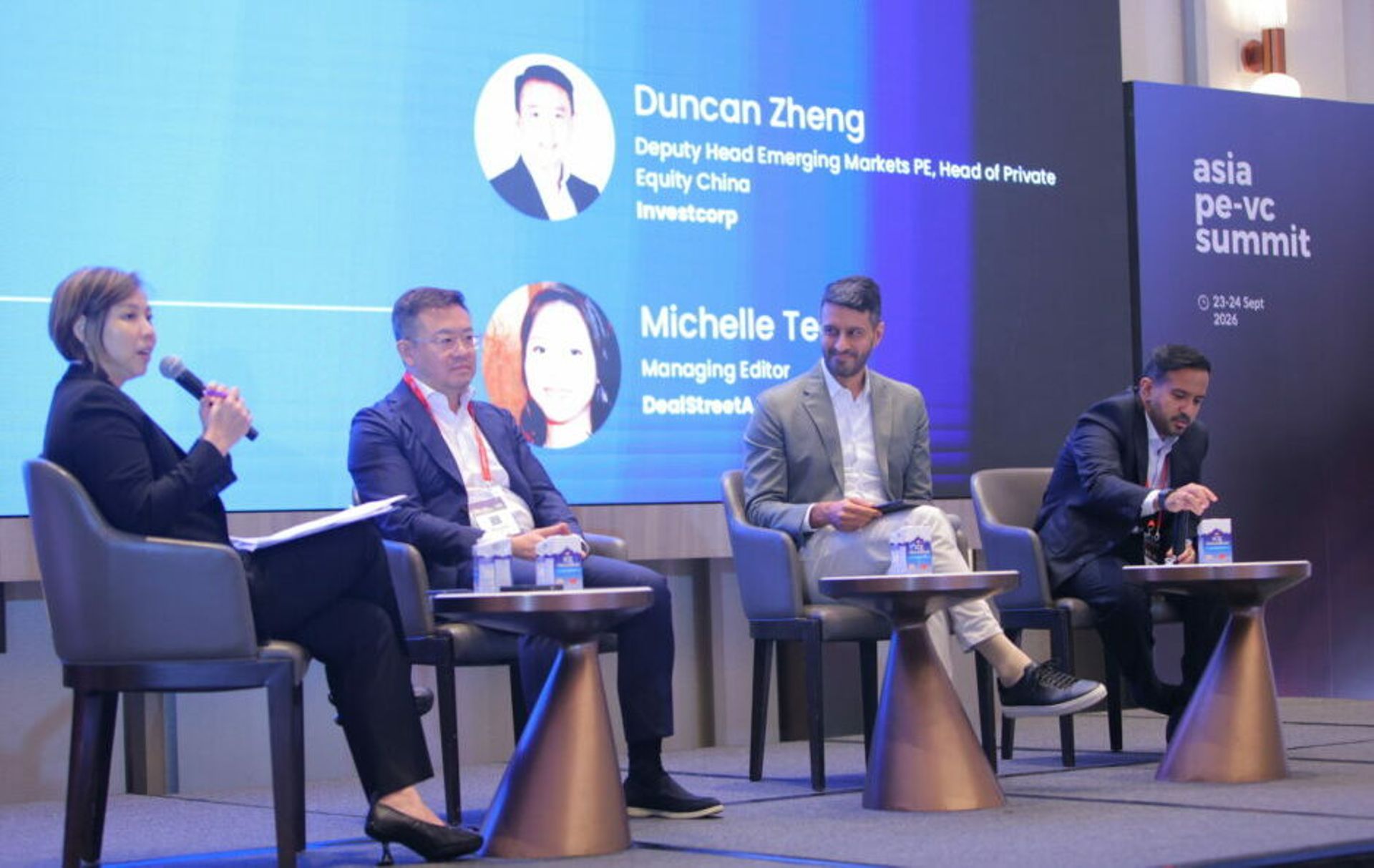
Albastaki was speaking during a panel discussion on ‘Is the Gulf’s new bargain with Asia moving beyond capital’ at DealStreetAsia’s Asia PE-VC Summit 2026 on Sept. 23 in Singapore.
The region’s fundamentals remain strong, with the market having adapted to the possibility of a prolonged conflict, the panellists asserted, noting that capital deployment is resilient. “All the secular drivers are still there. It’s a very young population—the size of approximately Germany, but you have the spending power of Germany plus Japan,” said Duncan Zheng, Deputy Head Emerging Markets PE, and Head of Private Equity China at Investcorp.
Importantly, there is a fundamental will to reform the economic power of the GCC, Zheng added, that will see the region come out stronger post-conflict.
There is a fundamental will to reform the economic power of the GCC that will see the region come out stronger post-conflict.
Investcorp is deploying in the region through its $750 million Golden Horizon Cooperation fund, in which about 40% of the limited partners are Chinese institutional investors, led by China Investment Corporation alongside Silk Road Fund, Bank of China, and insurers, among others.
“We are taking advantage of the volatility in the market. Companies last year would have been valued at 15x EBITDA. Today we can probably buy them at 10x [EBITDA] or below,” Zheng said.
In the view of Turki Al-Dayel, the founder and CEO of Growth Catalyst Investment Company, a Saudi private equity firm, local relationships and on-the-ground experience provide the firm a competitive advantage over external managers. And the mid-market space in Saudi Arabia and the wider GCC is a very “compelling space”, he noted.
“There are one million registered SMEs in Saudi Arabia. Twenty-five to 30,000 [of them] generate revenue between close to 50-250 million SAR. That is around $13 million to $80 million of revenue. They’re mid-sized companies, but they want to be the large new high-cap companies. And these are all private companies. So, our fund is to identify ten to twelve of those high-generating mid-market private companies for that next wave of growth.
Growth Catalyst is in the process of raising its debut fund, and is aiming to close on target at $200 million at the end of this year. The fund will be about 85% deployed into Saudi Arabia, with the remainder into the wider GCC region.
“LPs are getting excited about the new wave of growth. They’ve been seeing this high growth, growing economy, and a robust capital market system,” Al-Dayel added, pointing to how the GCC region has recently drawn the highest amount of venture capital funding in emerging markets, and its IPO markets have been one of the most robust, with some 50 public market debuts across the region last year.
Sectors of interest
To be sure, sovereign signalling is helping to sustain deployment.
Said Albastaki: “The minute the dollar is deployed somewhere, there’s the backing of a strategy that’s aligned, capital that’s aligned that’s then being put to work. Governments don’t spend money for the sake of spending money. It’s strategically bound. Every country has 10-plus-year strategic plans for where these dollars are going.”
Albastaki pointed to a region rich in myriad opportunities from fintech, supply chain and logistics, to health and life sciences, as well as large infrastructure projects including AI-related facilities.
“Every single one of these projects, whether it’s in Saudi, the UAE, or the wider region, needs operational efficiencies, scalability, and technology inclusions that layer on top of what they’re developing,” he said. “Infrastructure on its own is a massive spend. Creating efficiencies with those spends is a big part of what we do. It’s finding managers that are finding some of the best solutions, [and] backing them.”
Further, as Al-Dayel noted, there are significant opportunities for cross-border growth.
For instance, Growth Catalyst Investment is invested in a company that is building the largest vaccine plant in Saudi Arabia, and which has signed technology transfer agreements with companies in India and South Korea, including Bharat Biotech and SK Bioscience. “There are inherent roots with Asian entrepreneurs and companies with GCC establishments,” Al-Dayel said.
In the case of Investcorp’s Golden Horizon platform, it is largely sector-agnostic with a dual mandate of driving business between China and the GCC, through investing about 70% of the fund into the latter, and the remainder into China.
Among the portfolio companies is Metra, an IT distributor that operates in Saudi Arabia and the UAE, as well as across the broader North Africa region including Egypt. As Zheng explained, the company saw growing demand from their customers for Chinese systems, and now about a quarter of its business is within the Greater China region.
More recently, Investcorp led the Series C1 financing for Chinese solar player PCG Power, which has now expanded into a number of markets in the GCC, including Oman and Saudi Arabia. Said Zheng: “Where we help them is to ensure they get access to the decision-makers in each of the countries they’re dealing with.”
Ultimately, the region’s plans for growth are going ahead, with the conflict likely providing an added impetus.
“It’s pushing everyone in the region, primarily us, sitting as allocators, to ask the question of where are we growing into? Is that push to go to larger markets?” said Albastaki. “We’re seeing a lot more of that strategy being pushed a lot earlier with underlying founders and GPs.”